EN
DCF Commitments vs the EUDR: What Buyers Ask For Beyond the Law
How buyers' deforestation- and conversion-free pledges differ from the EUDR: the land they cover, their cut-off dates, and the plot evidence that answers both.
A buyer's deforestation- and conversion-free (DCF) commitment usually asks more of your plots than the EU Deforestation Regulation (EUDR). The EUDR's deforestation test only covers forest, with a cut-off of 31 December 2020. A DCF commitment also covers savannah, grassland, wetland and other natural ecosystems, and can use an earlier cut-off: 1 January 2014 for Rainforest Alliance. So a plot that meets the EUDR's land test can still fail your buyer. The fix starts with the same plot data and more history: every plot mapped, and what its land was back to the earliest cut-off any buyer uses.
This guide is for coffee and cocoa exporters and cooperatives whose EU buyers have their own deforestation pledges. For what the law alone asks, see EUDR for exporters and EUDR for cooperatives.
Checked 1 November 2026: against Regulation (EU) 2023/1115 (consolidated 18 September 2026), the Accountability Framework's
definitions,
core principles and
cutoff dates guidance (September 2023), the SBTi
FLAG Guidance v1.2 (March 2026), the Rainforest Alliance
Environment Annex v1.3 and the
Fairtrade Standard for Coffee (version of 8 October 2026). A plain-language summary, not legal advice.
What is a DCF commitment?
A DCF commitment is a company's promise that what it produces or buys did not cause deforestation or the conversion of any natural ecosystem after a fixed cut-off date. It is voluntary: the buyer chooses it, then often writes it into its sourcing policy and supplier contracts, where it binds the exporters that sign them.
This guide uses the definitions of the Accountability Framework (AFi), a set of common norms written by a coalition of environmental and human rights groups, which SBTi's FLAG guidance also recommends. Two of its definitions do most of the work:
- Deforestation is the loss of natural forest by conversion to agriculture or another non-forest land use, by conversion to a tree plantation, or by severe and sustained degradation.
- Conversion is the loss of any natural ecosystem, forest or not, by replacing it with agriculture or another land use, or by a deep and lasting change to its species, structure or function. Deforestation is one kind of conversion.
Both count "regardless of whether or not it is legal". A permit to clear doesn't make the land DCF.
How is a DCF commitment different from the EUDR?
| EUDR | DCF commitment (AFi definitions) | |
|---|---|---|
| What it is | EU law, from 30 December 2026; from 30 June 2027 for natural persons and micro or small operators established as such by 31 December 2024, except for EU Timber Regulation products (Article 38) | A buyer's voluntary commitment, binding on suppliers through its contracts |
| Commodities | Cattle, cocoa, coffee, oil palm, rubber, soya, wood and the products listed in Annex I (extracts, essences and concentrates of coffee from 30 December 2027) | Whatever the buyer commits to; AFi asks for all relevant commodities |
| Land it protects | Forest (Article 2(4)), planted timber forest included | Natural forest and every other natural ecosystem (Core Principle 1) |
| What counts | Forest converted to agricultural use, whether people caused it or not (Article 2(3)); for wood, also degradation | Loss of natural forest or any natural ecosystem, including to a tree plantation or by severe and sustained degradation |
| Cut-off date | 31 December 2020 (Article 2(13)) | Set by each buyer, no later than the date it issues the commitment; for deforestation no later than 2020 |
| Legal clearing | Still deforestation; legality is a separate test | Still deforestation or conversion |
| Rights | Produced under the country's laws on the topics in Article 2(40), FPIC included | Respect for human rights, FPIC included (Core Principle 2) |
| Traceability | Every plot geolocated; a polygon for plots over 4 ha, cattle excepted (Articles 9(1)(d) and 2(28)); eligible micro and small primary operators may give a postal address | Origins known or controlled well enough to show the production and processing units comply (Core Principle 5) |
| Evidence | A due diligence statement, or a one-off simplified declaration for eligible micro and small primary operators (Articles 4, 4a) | Monitoring, verification and reporting (Core Principles 11–12) |
| Who checks | EU member-state authorities | The buyer, its auditors and certification bodies |
For the EUDR's other dates, the small-operator rules and record keeping, see EUDR for exporters.
Which land does each one cover?
The biggest difference is what the land was before it was planted. Each row assumes clearing after both cut-off dates, and covers only the land test: legality and due diligence apply on top.
Natural forest, primary or regrown
EUDRDeforestation
DCF commitment (AFi)Deforestation
Timber tree plantation that isn't natural forest
EUDRDeforestationPlanted and plantation forest are forest (Articles 2(10), 2(11)).
DCF commitment (AFi)Not deforestationAFi counts only the loss of natural forest; where the law is stricter, companies follow it (Core Principle 3.4).
Natural shrubland or open woodland that isn't forest ("other wooded land")
EUDROutside the testArticle 2(12); the 2030 review will evaluate adding it (Article 34(2)(g)).
DCF commitment (AFi)Conversion
Natural grassland, peatland or wetland without forest
EUDROutside the testThe 2030 review will evaluate adding them (Article 34(2)(h)).
DCF commitment (AFi)Conversion
Coffee, cocoa or other crops, including agroforestry
EUDRAgricultural landNot forest (Articles 2(4) and 2(6)).
DCF commitment (AFi)Usually agricultureLow-intensity, small-scale cultivation inside a forest can still be natural forest where most of the forest's species, structure and function remain (AFi definition of natural forest).
What cut-off dates do coffee and cocoa buyers use?
A buyer may follow several of these at once. The AFi says to use the earliest that applies (cutoff dates guidance, section 2).
- 1 January 2014Rainforest Alliance; Fairtrade coffee, in force since 2025
- 31 December 2018Fairtrade coffee, from 1 January 2027
- 31 December 2020EUDR
- No later than 2020Each buyer's own date for deforestation (Accountability Framework); best practice in SBTi FLAG
| Rule | Land it covers | Source |
|---|---|---|
| EUDR | Forest | |
| Accountability Framework | Natural forest and other natural ecosystems | |
| SBTi FLAG targets | Deforestation required; no-conversion recommended | |
| Rainforest Alliance | Natural forest and natural ecosystems | |
| Fairtrade coffee | Primary and secondary forest, protected areas, and High Conservation Value or carbon-storage areas |
The Accountability Framework sets no single date: a buyer's cut-off should be no later than the date its commitment is issued, and for deforestation no later than 2020; it should adopt the common date where one applies, unless it already set an earlier one, which it keeps. SBTi FLAG treats 2020 or earlier as best practice, and allows a later date only for parts of a supply chain where 2020 would cause harm, such as excluding smallholders: at least 3 years before the company first submits FLAG targets, with the date and reason disclosed, and 2020 or earlier kept everywhere else. Fairtrade coffee's 2014 date means no indication of deforestation or degradation since then; its 2018 date, no deforestation or degradation since then.
Rainforest Alliance has a narrow remedy for conversion that happened between 1 January 2014 and 31 December 2020 and is found before a farm's first certification audit: up to 1% of the farm or 10 hectares, whichever is smaller (1% of the farm unit for small farms in a group). It is decided case by case, and the farm must carry out, monitor and report an ecologist's restoration plan for an area at least as large and of equal ecological value, or larger where its value is lower; for small farms in a group, the group management is accountable (Environment Annex, sections 1.4 and 1.4.1). Ask each buyer which dates it uses, and keep the answer with its contract.
When does a plot pass one and fail the other?
Each case looks only at land history; legality and due diligence still apply.
Coffee planted in 2022 on cleared natural shrubland
The shrubland never met the EUDR's forest definition: under 10% canopy, with no trees that could grow past it in place.
- EUDR land testPassesIt was never forest.
- Conversion-free buyerFailsAny cut-off before 2022 catches it, Rainforest Alliance's 2014 date included.
Cocoa planted in 2017 on forest cleared in 2016
The clearing was before 31 December 2020.
- EUDR land testPasses
- Buyer using the 2014 dateFailsRainforest Alliance's remedy saves the plot only if the cleared area fits inside its cap: the smaller of 1% of the farm and 10 hectares, or 1% of the farm unit for small farms in a group.
Coffee planted in 2021 on a eucalyptus plantation cleared that year
The plantation was set up decades earlier on pasture.
- EUDR land testFailsA plantation forest is forest, so the coffee can't be placed on the EU market.
- AFi definitionsNot deforestationThe plantation wasn't natural forest, but the AFi says companies follow the stricter rule where the law and their commitment differ (Core Principle 3.4).
What should an exporter collect to answer both?
One plot list can support the law and your buyers' checks, if it holds more than the EUDR minimum. A buyer may still ask for more.
- A boundary for every plot you can walk. The EUDR accepts a point for plots of 4 hectares or less, but a boundary shows the land cover across the whole plot, not just one spot. See EUDR geolocation for the format.
- Land history back to the earliest cut-off. If any buyer uses 2014, look at each plot on imagery from before 2014 as well as from 2020.
- What the land was, not just forest or no forest. A forest map for 2020 helps check whether a plot was forest, within the map's accuracy. It doesn't show cleared shrubland or a drained wetland. Record the land type before planting.
- Rights records. Land documents, consent and labour records support both the EUDR's legality check and a buyer's human rights clause, though neither stops there.
- The rest of the farm. Some buyers assess the whole production unit: every plot under one management in the same area, including forest and other land managed with them (AFi definition of production unit).
- Each buyer's dates and land types. Keep one list of which buyer uses which cut-off, and check new plots against the strictest.
Where does Restoration Scope fit?
Restoration Scope builds digital infrastructure for nature projects: software for carbon and nature restoration projects that connects each team's field data, maps and workflows in one system. For an exporter or cooperative, that means one record per plot, with its boundary mapped on a phone in the field, offline, and the plot's land history next to it. Every team sees each plot over past satellite imagery, and we set up the layers your buyers care about, such as land cover and tree cover loss, so the compliance team can set each plot's review status before a lot ships.
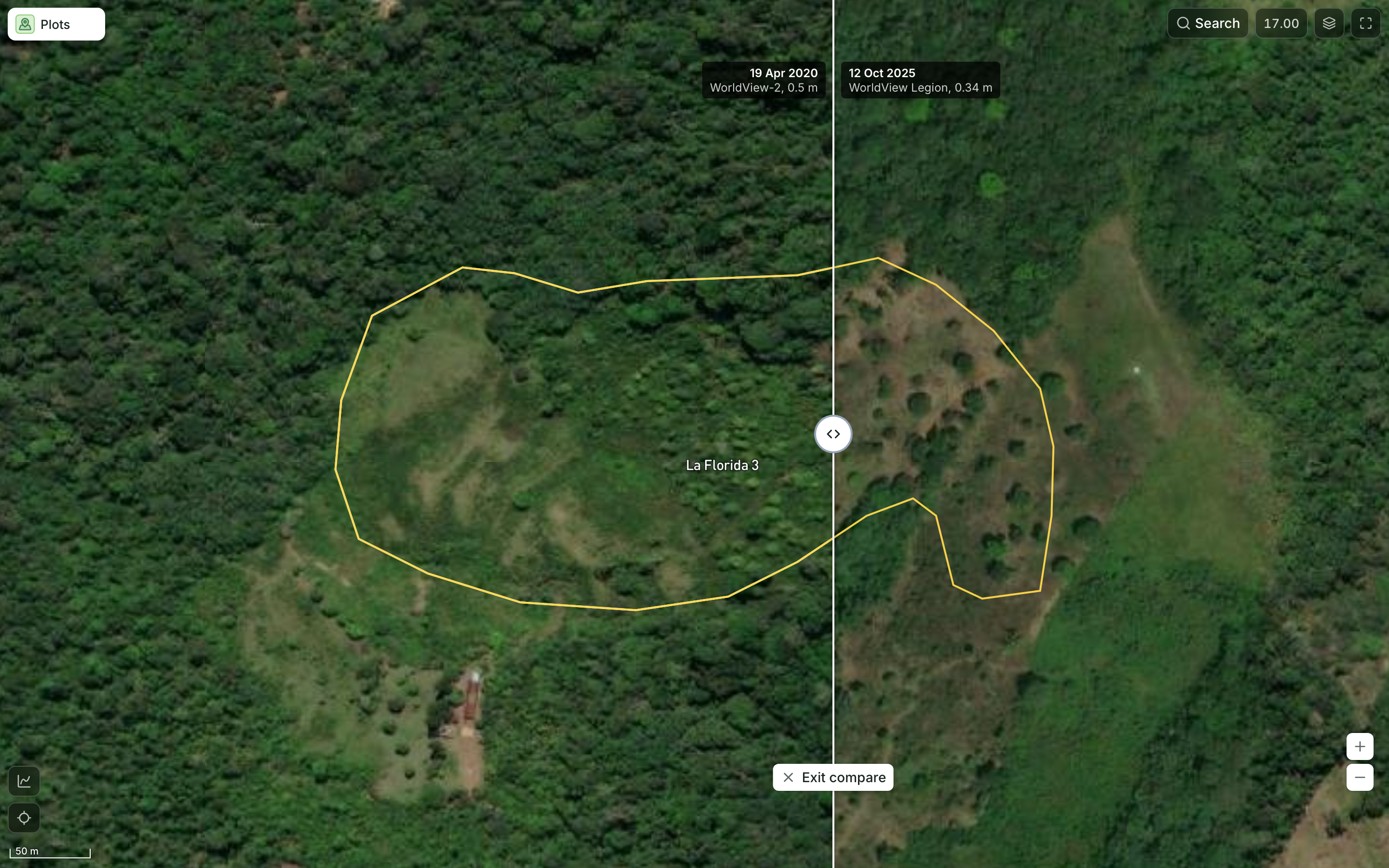
The same plot in April 2020 and October 2025.
One coffee plot outlined on satellite imagery from April 2020 and October 2025, split by a swipe divider, so the team can see what changed before setting its review status. Demo cooperative: producers, plot records, risk cases and field visits are made up, and deforestation statuses, check results and cutoff figures are not computed by Restoration Scope. Plot locations, map layers and imagery are real.
Good fit: an exporter or cooperative that keeps one plot list for the EUDR and for buyers with their own commitments, with help setting it up.
Think twice if: you want a verdict on each plot. We don't run an automatic cut-off check or give a compliance verdict; your team, and your buyer, make the call.
Cost: a free pilot on a sample of your data, then a platform license plus implementation, quoted after a scoping call.
Where to start
Ask your three largest EU buyers two questions this week: which cut-off date they use, and whether their commitment covers conversion of land that isn't forest. If any answer is 2014, or yes, start checking plots against that date before the next harvest is sold. For the full EUDR checklist, see EUDR compliance checklist.
Disclosure: We make Restoration Scope, field and plot software that exporters and cooperatives use to keep plot data for the EUDR. No standard or buyer named here paid for or reviewed this guide.
Learn everything about the EUDR
From what the regulation asks to mapping plots, tracing lots and reviewing the evidence, in the order teams need it.
Review the evidence
- GuideEUDR compliance checklist
- GuideFiling the statement in TRACES
- GuideScreening plots with Whisp
- GuideDCF commitments vs the EUDRYou’re reading this
- Free toolPlot imagery viewer
- ProductDeforestation evidence
- ProductData quality
See it workingUp next
Questions about DCF commitments and the EUDR
What does deforestation- and conversion-free (DCF) mean?
A company's commitment that the commodities it produces or buys did not cause the loss of natural forest (deforestation) or of any other natural ecosystem, such as savannah, grassland or wetland (conversion), after a set cut-off date. The Accountability Framework gives common definitions for these commitments, and SBTi's FLAG guidance recommends them. It counts loss whether or not it was legal.
Is a product that complies with the EUDR also DCF?
Not necessarily. The EUDR's land test only looks at forest, so coffee planted after 2020 on cleared natural shrubland that was never forest can meet that test and still break a conversion-free commitment. A buyer can also use an earlier cut-off date: Rainforest Alliance uses 1 January 2014.
What cut-off date does the Accountability Framework use?
It sets no single date. Its cutoff dates guidance (September 2023) says cut-offs should be no later than the date the commitment is issued, and for deforestation no later than 2020; that companies should adopt a common cut-off date where one applies, unless they already set an earlier one; and that where several apply the earliest should be used. For non-forest ecosystems it recommends a date as early as feasible.
Does the EUDR cover savannah, grassland or wetland?
Only where the land meets its forest definition in Article 2(4); a forested peat swamp is forest. Other wooded land that isn't forest, and grasslands, peatlands and wetlands without forest, are outside its deforestation test, though products grown there still have to meet its legality and other requirements. Its first general review, due by 30 June 2030, evaluates possibly extending the rules to other wooded land, together with the cut-off date in Article 2(13) (Article 34(2)(g)), and whether to extend them to other natural ecosystems such as grasslands, peatlands and wetlands (Article 34(2)(h)).
Can land fail the EUDR's land test and still meet a DCF commitment?
Not in practice, though the land can pass the Accountability Framework's definitions. The EUDR counts planted and plantation forest as forest, so clearing a timber plantation for coffee after 31 December 2020 is deforestation under the EUDR. The Accountability Framework only counts the loss of natural forest, so clearing a tree plantation that isn't natural forest, and wasn't planted on land cleared after the cut-off, isn't deforestation under its definitions. It is still deforestation under the EUDR, so the coffee can't be placed on the EU market, and where a commitment and the law differ, the AFi says companies follow the stricter one (Core Principle 3.4).
Why are buyers asking for DCF evidence now?
Many buyers set public targets. Companies with Science Based Targets for forest, land and agriculture (SBTi FLAG) must publicly commit to no-deforestation supply chains for their primary deforestation-linked commodities (no-conversion is recommended, not required), with a target date no later than two years after they submit their targets and never later than 31 December 2030. SBTi recommends that companies already committed to 2025 keep that date; those that update it must first publicly disclose their progress, barriers and planned actions, keep their existing cut-off date, and set a new date within two years of resubmitting, and no later than 31 December 2028 (FLAG Guidance v1.2, March 2026, FLAG-C4 and section 3.2).
Another question? Email us or book a call.
Based on the official EU texts. See our EUDR sources, with the version we follow and the day we last checked each one.