EUDR Compliance Checklist: From Scope to Statement
A step-by-step EUDR compliance checklist for compliance and sustainability teams: scope, information, risk, the due diligence statement and records.
EUDR compliance means every relevant product you place on the EU market or export comes from land not deforested after 31 December 2020, was produced legally, and is covered by the applicable statement or simplified declaration. Behind it sits due diligence in three steps: collect the information, assess the risk, mitigate it until it is negligible. It applies from 30 December 2026, with a later date for some micro and small operators (step 1). This checklist runs through the work in order, from scope to the records you keep afterwards.
It is written for compliance and sustainability teams at exporters, cooperative unions and EU importers. The regulation itself is explained in what is the EUDR.
Checked 21 October 2026: against Regulation (EU) 2023/1115 as amended by
Regulation (EU) 2025/2650,
Implementing Regulation (EU) 2024/3084 and its
2026 amendment, the Commission's
FAQ and the
user guide for operators. A plain-language summary, not legal advice.
1. Are you in scope, and from when?
- Your role. Operator (first to place on the EU market or export: files statements), downstream operator or trader (files nothing, keeps records). A company outside the EU that places goods makes its first EU buyer an operator too (Article 7). A scope checker walks through the questions.
- Your products. Check each customs code against Annex I with a code lookup.
Delegated Regulation (EU) 2026/2102 adds soluble coffee and palm oil derivatives from 30 December 2027, and removes some products such as cattle hides and leather.
- Your date. The rules apply from 30 December 2026. Qualifying micro and small operators established as such by 31 December 2024 have until 30 June 2027, except for products from the old EU Timber Regulation (Article 38). Traders and downstream operators follow the December 2026 date. A delay checker shows which applies to you.
- Your account. Register in the EU's
Information System on TRACES with the right activity type. Downstream operators and traders above SME size must register too (Article 5(2)). Practise on the acceptance server first; its submissions have no legal value.
2. What information do you collect for each product?
Article 9 lists it. For every product you place or export:
- Description, customs code and quantity (kg of net mass for imports and exports).
- Country of production.
- Geolocation: for commodities other than cattle, every plot, with a polygon for plots over 4 hectares; for cattle, every establishment where they were kept. Six decimals, GeoJSON in WGS84. Run each file through a plot file checker. The rules are in what geolocation the EUDR requires.
- Date or time range of production. A harvest season is enough when nothing more precise exists (FAQ 1.25).
- Suppliers and customers: name, postal address, email.
- Evidence the land was not deforested after 31 December 2020 and, for wood, that it was harvested without forest degradation after that date.
- Evidence of legal production: land use rights, environmental and forest law, third parties' and indigenous peoples' rights, labour and human rights, free, prior and informed consent, tax, anti-corruption, trade and customs.
Suppliers outside the EU hold most of this. The guides for cooperatives and exporters are written for them.
3. How do you assess the risk?
Article 10 lists what to weigh. Record each one, with the date and who decided:
- The country's risk level under
- Forest in and around the plots, and indigenous peoples in the area.
- How complex the supply chain is, and the risk of mixing with products of unknown origin.
- Concerns about the country, such as corruption or falsified documents.
- Certification or third-party checks, as supporting information only.
For the deforestation question, look at each plot: imagery from before the cutoff and today, side by side in an imagery viewer, and more than one forest map. The JRC Global Forest Cover 2020 map is a reference, not the legal baseline (FAQ). Give each plot a review status your team sets, such as reviewed, in review, needs follow-up or not reviewed, and write down why. A plot inside mapped forest isn't automatically out; a plot outside it isn't automatically in.
4. What do you do when the risk isn't negligible?
- Ask the supplier for more information or documents.
- Commission an independent survey or audit, or a field visit to the plot.
- Support the supplier to fix the gap, for example remapping a plot.
- Hold the product until the risk is negligible (Article 11). If it can't be, don't place it.
5. What goes into the due diligence statement?
- Your name, address and EORI number for imports and exports (Annex II).
- Customs code, description, quantity, country of production and the plots' geolocation. A statement prep sheet lists the fields in the order the system asks for them.
- Submit, then sign. The system returns a reference number and a verification number after its own risk profiling.
- Give the reference number to customs before release or export (Article 26(4)), and to the first downstream operator or trader (Article 4(7)).
- Check it within 72 hours: that is the window to amend or withdraw it, unless the goods are already placed, a check has been announced or the number has gone to customs. Grouped statements can't be changed.
- Micro and small primary operators in low-risk countries file a one-time simplified declaration instead (Article 4a); due diligence still applies.
- Mind the limits: up to 25 MB of geolocation per statement. Statements can be grouped under one reference when one isn't enough.
6. What do you keep doing after filing?
- Keep statements and the information behind them for five years.
- Tell the authorities and your customers if you learn of a new risk (Article 4(5)).
- Review your due diligence system at least once a year (Article 12).
- Keep plots current: new members, new plots and changed boundaries go through steps 2 and 3 again.
What do teams most often miss?
- Legality. A plot with no forest loss still fails if the land was taken without the right to use it.
- Points for large plots. For commodities other than cattle, plots over 4 hectares need polygons. For cattle, provide every establishment where they were kept. A point with no area is read as 4 hectares by the EU system.
- Production dates. Required in your records (Article 9(1)(d)), even though the statement form doesn't ask for them.
- One-off mapping. Plots change hands and boundaries move. A plot list from 2025 won't describe the 2027 harvest.
Where does Restoration Scope fit?
Restoration Scope builds digital infrastructure for nature projects: software for carbon and nature restoration projects that connects each team's field data, maps and workflows in one system. For a compliance team, that means each plot's record shows its boundary over 2020 imagery and forest maps, the review status your team sets, and the data problems to send back to the field team: plots not mapped yet, a point used for a plot over 4 hectares, a mapped area that differs from the declared one.
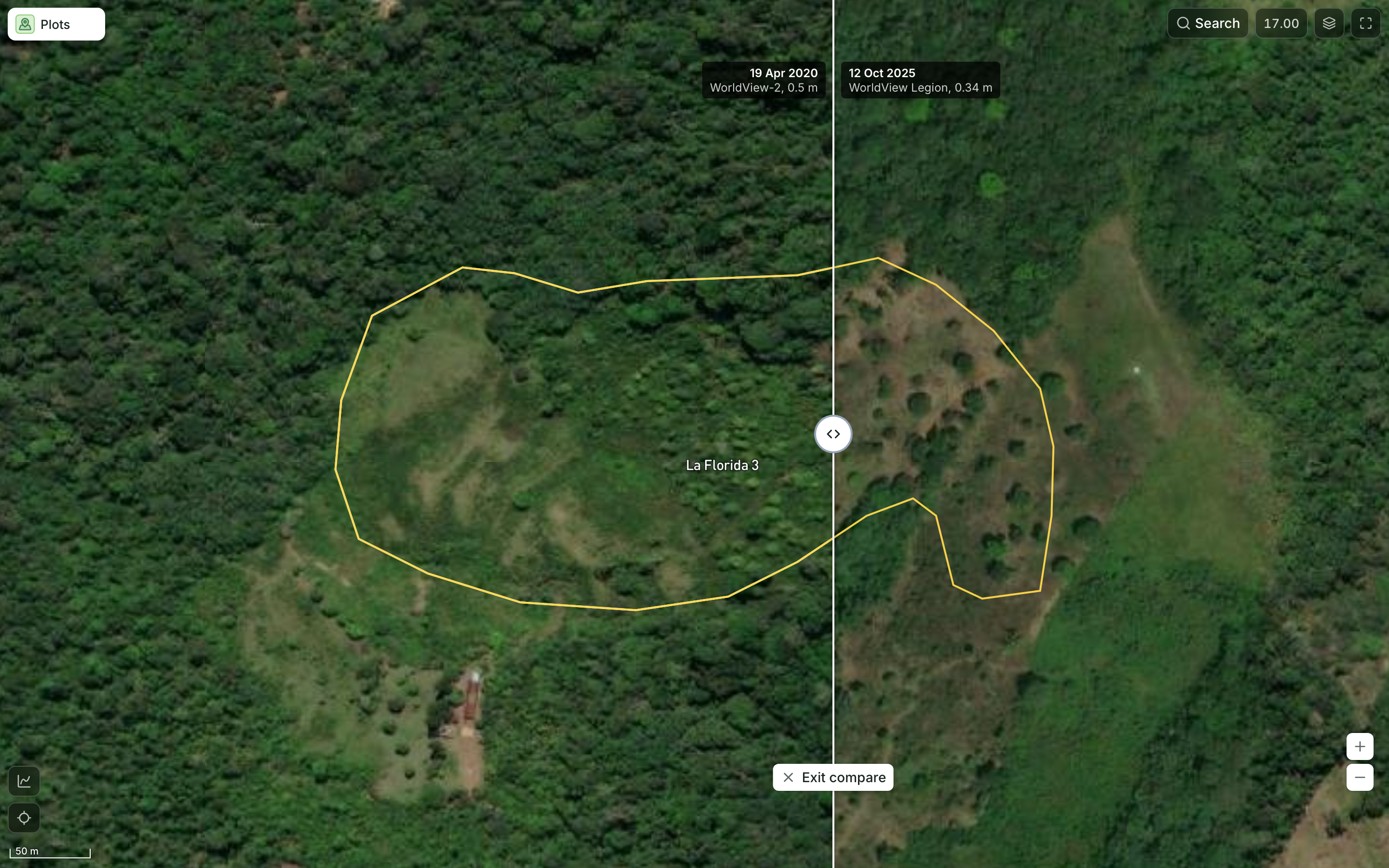
The same plot in 2020 and today.
One coffee plot outlined on satellite imagery from April 2020 and October 2025, split by a swipe divider, so the team can see what changed before setting its review status. Demo cooperative: producers, plot records, risk cases and field visits are made up, and deforestation statuses, check results and cutoff figures are not computed by Restoration Scope. Plot locations, map layers and imagery are real.
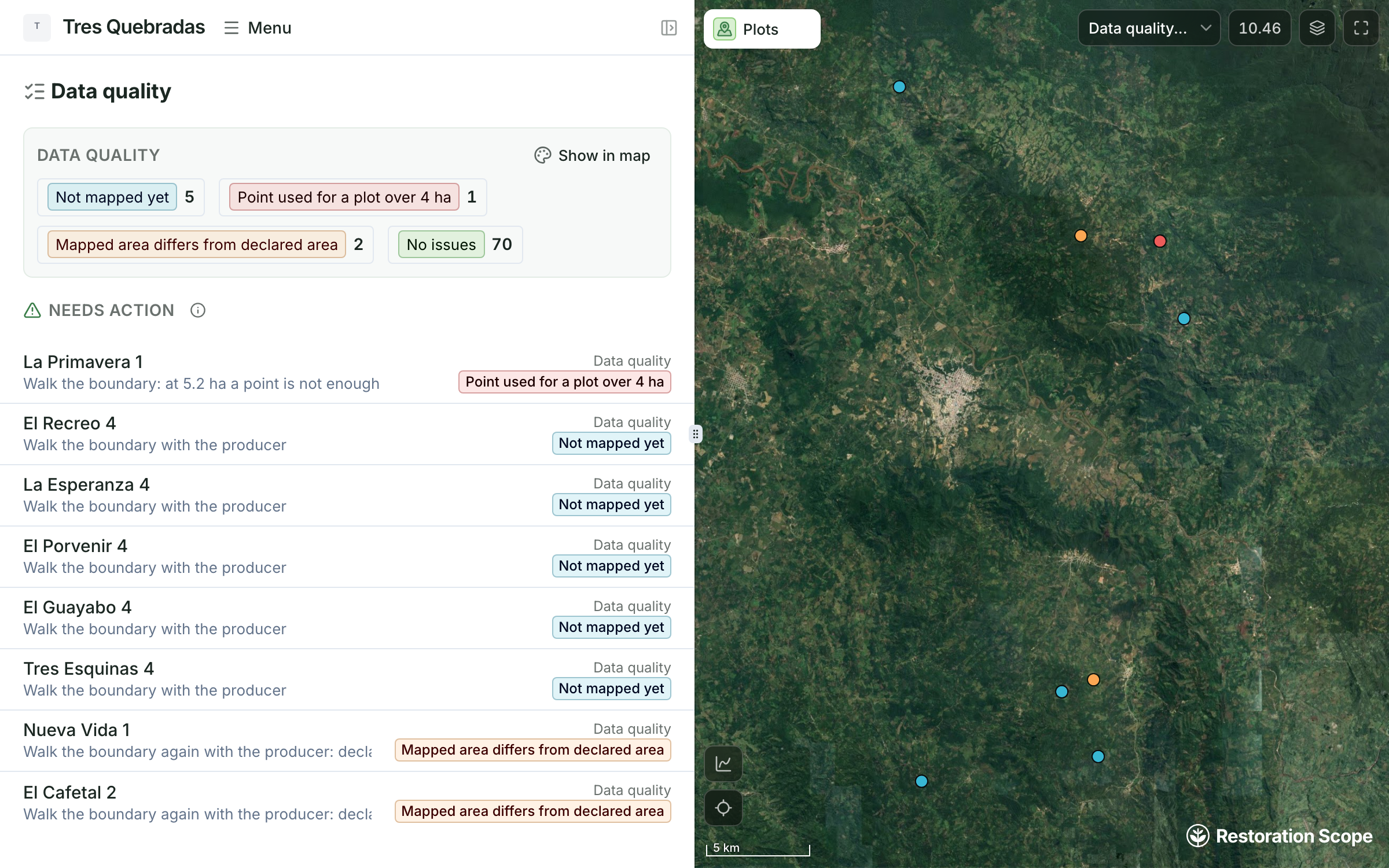
The data problems to send back.
Plots not mapped yet, a point used for a plot over 4 hectares and mapped areas that differ from the declared ones, each with the field team's next step, beside those plots on the map. Demo cooperative: producers, plot records, risk cases and field visits are made up, and deforestation statuses, check results and cutoff figures are not computed by Restoration Scope. Plot locations, map layers and imagery are real.
Good fit: a team that reviews plots from its own suppliers and wants the field data, the evidence and its decisions in one record per plot.
Think twice if: you want software to decide for you. We don't run an automatic cutoff check, give a compliance verdict or file statements; your team makes the call.
Cost: a free pilot on a sample of your data, then a platform license plus implementation, quoted after a scoping call.
Where to start
Settle step 1 first: role, products and date decide everything else. Then pick one supplier and run it through steps 2 to 5 on the acceptance server before your date. The tools for each step are compared in tools for EUDR geolocation data.
Learn everything about the EUDR
From what the regulation asks to mapping plots, tracing lots and reviewing the evidence, in the order teams need it.
Review the evidence
- GuideEUDR compliance checklistYou’re reading this
- ProductDeforestation evidence
- ProductData quality
See it workingUp next
Frequently asked questions
What does EUDR compliance mean?
Every relevant product you place on the EU market or export comes from land not deforested after 31 December 2020, was produced legally in its country, and is covered by the applicable statement or simplified declaration, backed by a due diligence system you review at least once a year and records you keep for five years.
Is there an EUDR certificate that proves compliance?
No. The regulation creates no certificate or label. Certification can support a risk assessment but cannot replace the operator's due diligence. What shows a product is covered is the reference number of its due diligence statement.
Is the EU forest map the legal baseline for the 2020 cutoff?
No. The Commission's FAQ calls the JRC Global Forest Cover 2020 map non-mandatory and not legally binding. Teams compare each plot with imagery and more than one forest source, and record what they decided and why.
Can a due diligence statement be changed after it is filed?
For 72 hours after the reference number is made available, unless the goods have been placed on the market, a check has been announced, or the number has gone to customs. After that, or once the statement is used in a group, it can no longer be amended or withdrawn, except that the authority may allow up to eight more days on a reasoned request when something beyond your control got in the way.
Do downstream operators and traders need a compliance process?
A lighter one. Since Regulation (EU) 2025/2650 they file no statement, but they keep supplier and customer details for five years, pass on new risk information, and the first one after the operator keeps the statement's reference number. Non-SMEs also register in the EU Information System.
Another question? Email us or book a call.