EUDR for Exporters: What Your EU Buyer Needs With Each Lot
What the EUDR asks of coffee and cocoa exporters outside the EU: the data each lot needs, how to collect it from suppliers, and when you file yourself.
An exporter outside the EU has no direct duty under the EU Deforestation Regulation (EUDR) unless it places the goods on the EU market itself. But its EU buyer needs data only the exporter can collect before lawfully placing the goods on the EU market: for each lot, the customs code and net mass, the country of production, the geolocation of every plot it came from, the production period, and evidence that the land was not deforested after 31 December 2020 and was farmed legally. Large EU buyers need it for goods placed on the market from 30 December 2026.
This guide is for coffee and cocoa exporters and traders in producer countries, who buy from cooperatives, intermediaries and their own farms. It covers what to send with each lot and the order to set it up in. For the regulation as a whole, see what is the EUDR.
Checked 21 October 2026: against Regulation (EU) 2023/1115 as amended by
Regulation (EU) 2025/2650, the Commission's
FAQ and the
EUDR user guide for operators (version 3.0, 16 September 2026). A plain-language summary, not legal advice.
Do exporters have EUDR obligations?
Only when they place goods on the EU market themselves. The duties fall on the operator: the first company to place a product on the EU market, or to export it from the EU (Article 2(15)). For coffee or cocoa shipped from Peru or Côte d'Ivoire, that is usually the EU importer.
Two cases change that:
- You are the importer of record. If your company clears the goods into the EU, it is the operator and files the statement. Filing for an import needs an EU EORI number (FAQ 3.7).
- You sell from EU stock. When a company outside the EU places goods on the EU market, the first EU company to buy and sell them on is also treated as an operator, and files its own statement (Article 7).
Either way, the data comes from the same place: your suppliers and your warehouse.
What does your EU buyer need with each lot?
| What | Where the rule comes from | Notes |
|---|---|---|
| Customs (HS) code and description | Annex II, item 2 | Coffee, green or roasted, is 0901; cocoa beans 1801. Soluble coffee joins the scope on 30 December 2027 |
| Quantity in kg of net mass | Annex II, item 2 | Without packaging |
| Country of production | Annex II, item 3 | One per plot; a lot from two countries lists both |
| Geolocation of every plot | Annex II, item 3; Article 2(28) | Six decimals; a polygon for plots over 4 hectares; GeoJSON in WGS84 |
| Production period | Article 9(1)(d) | The harvest season is enough when nothing more precise exists (FAQ 1.25) |
| Suppliers | Article 9(1)(e) | Name, address and email of whoever sold you the coffee |
| Deforestation-free and legal evidence | Article 9(1)(g)–(h) | Imagery or maps for each plot; land and legality documents |
A code lookup tells you whether a product's customs code is in Annex I.
What should an exporter do, and in what order?
- List your EU buyers and their dates. The rules apply from 30 December 2026. Qualifying micro and small operators established as such by 31 December 2024 have until 30 June 2027, except for products from the old EU Timber Regulation. Traders and downstream operators follow the December 2026 date. Ask each for its data list and file format.
- List your suppliers and what they can give you. Cooperatives often have plot lists; intermediaries often don't. Start with the suppliers behind your largest EU volumes.
- Collect plots from every supplier. One row per plot, with a stable ID, its producer and its area. Our guide for cooperatives is the one to send them.
- Check every file you receive. Open rings, self-crossing shapes, swapped coordinates and points used for plots over 4 hectares get uploads rejected. A plot file checker catches them before your buyer does.
- Keep lots traceable to plots. Record which deliveries, from which plots, went into each lot, and keep EU lots apart from coffee you can't trace. A lot with coffee from even one unmapped plot can't be covered.
- Prepare a file per shipment. One GeoJSON file with the lot's plots, plus the code, net mass, country and production period. A statement prep sheet lists each field the buyer will enter. The EU system takes up to 25 MB of geolocation per statement; bigger shipments split across several statements.
- Keep the evidence for five years. Buyers must keep their records for five years and authorities can ask them to show the source; they'll ask you.
Does the country's risk level change what you send?
Not the data. Under Implementing Regulation (EU) 2025/1093, Brazil, Colombia, Peru, Côte d'Ivoire, Ethiopia and Indonesia are standard risk; Ghana and Vietnam are low risk. Simplified due diligence may apply (Article 13) after the operator checks supply-chain complexity and risks of circumvention or mixing, and confirms all relevant material comes from low-risk countries. Relevant risk information requires full assessment and mitigation. Either way, your buyer still needs the geolocation and the rest of the information. From a standard-risk country, expect more questions about flagged plots and land documents.
Where does Restoration Scope fit?
Restoration Scope builds digital infrastructure for nature projects: software for carbon and nature restoration projects that connects each team's field data, maps and workflows in one system. For an exporter, that means one record per plot across all your suppliers, with harvest recorded by plot and grouped into lots. Open a lot and see every farm in it, with its producer, area and harvest, then download the lot's plots as one GeoJSON file for your buyer. Your compliance team looks at each plot over 2020 imagery and forest maps and sets its review status.
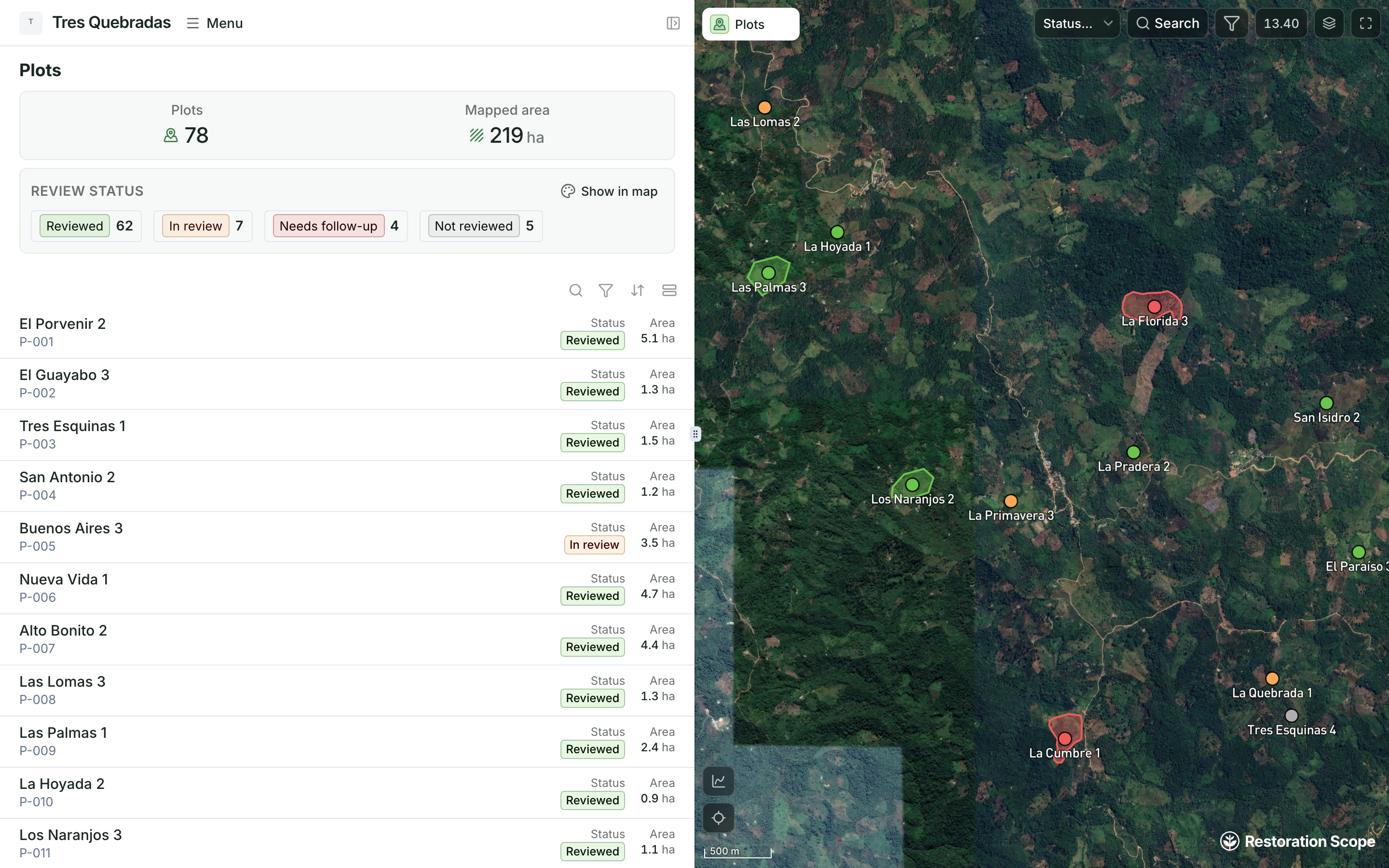
Every plot on one map.
The plot list with each plot's review status, beside the map where each plot is a boundary or a point. Demo cooperative: producers, plot records, risk cases and field visits are made up, and deforestation statuses, check results and cutoff figures are not computed by Restoration Scope. Plot locations, map layers and imagery are real.
Good fit: an exporter that buys from many suppliers and wants their plots, harvest and lots in one place, with field teams to keep plots current.
Think twice if: you want a verdict on each plot. We don't run an automatic cutoff check, give a compliance verdict or file statements; your team, and your buyer, make the call.
Cost: a free pilot on a sample of your data, then a platform license plus implementation, quoted after a scoping call.
Where to start
Ask your largest EU buyer for its data list this month, then map the suppliers behind that buyer first. The rules for the plot file itself are in what geolocation the EUDR requires, and the tools to collect and check it in tools for EUDR geolocation data.
Learn everything about the EUDR
From what the regulation asks to mapping plots, tracing lots and reviewing the evidence, in the order teams need it.
Trace each lot to its plots
- GuideEUDR for exportersYou’re reading this
- ProductHarvest and lots
- ProductThe file for your EU buyer
- Free toolDue diligence statement prep sheet
Review the evidenceUp next
Frequently asked questions
Do exporters outside the EU have EUDR obligations?
Not as a rule. The EUDR's duties fall on the operator, the first company to place the product on the EU market, which is usually the EU importer. An exporter becomes an operator only if it places the goods on the EU market itself, for example as importer of record.
What does an EU importer need from an exporter for each lot?
The customs code, description and net mass of the product, the country of production, the geolocation of every plot the lot came from, the production period, the suppliers, and evidence that the land was not deforested after 31 December 2020 and was farmed legally.
Can an exporter mix coffee from mapped and unmapped plots?
Not in a lot going to the EU. The due diligence statement needs the geolocation of every plot the product came from, so a lot that includes coffee from plots nobody can locate cannot be covered.
Does a low-risk country rating remove the need for plot data?
No. Products from low-risk countries still need the plot geolocation and the other information. Simplified due diligence may apply after the operator checks supply-chain complexity and risks of circumvention or mixing, and confirms all relevant material comes from low-risk countries. Relevant risk information requires full assessment and mitigation.
How large can a plot file for one statement be?
The EU Information System accepts up to 25 MB of geolocation per due diligence statement, including uploaded GeoJSON. Larger shipments can be split across several statements, which can then be grouped.
Another question? Email us or book a call.