EN
EUDR for Cooperatives: What to Do, and in What Order
What the EUDR asks of coffee and cocoa cooperatives: the plot data EU buyers need, the order to collect it in, and when a cooperative files itself.
A coffee or cocoa cooperative that sells through an exporter or importer, and does not place its crop on the EU market itself, has no direct legal duty under the EU Deforestation Regulation (EUDR). But its EU buyer needs the cooperative's data before lawfully placing the goods on the EU market: for every lot, plot locations, harvest dates and evidence the land was not deforested after 31 December 2020 and was farmed legally. So its job is a plot list: every member and plot, mapped, kept current and linked to the harvest. The rules apply from 30 December 2026.
This guide is for the managers and technical teams of cooperatives, producer organisations and associations. It covers what buyers ask for, the order to do the work in, and when a cooperative becomes an operator itself. For the regulation as a whole, see what is the EUDR.
Checked 21 October 2026: against Regulation (EU) 2023/1115 as amended by
Regulation (EU) 2025/2650, and the Commission's
FAQ. A plain-language summary, not legal advice.
What does the EUDR ask of a cooperative?
The regulation puts its duties on the operator: the company that first places the product on the EU market, usually the EU importer. The Commission's FAQ says the regulation places no legal obligations on producers outside the EU.
For its due diligence, the operator must collect and keep this information for every product (Article 9). Some also goes into the statement:
- The geolocation of every plot the commodity came from, and the country of production.
- The date or time range of production. A crop year or harvest season is enough when nothing more precise exists (FAQ 1.25).
- Who supplied it, with names and addresses.
- Evidence it is deforestation-free, meaning the land was not forest turned into farmland after 31 December 2020.
- Evidence it is legal: land use rights, environmental and labour law, the rights of indigenous peoples and third parties, tax and trade rules in the country of production.
Most of that sits with the cooperative. An importer who can't get it can't lawfully place the goods on the EU market.
What should a cooperative do, and in what order?
- List every member and every plot. One row per plot, not per farm: a member with three separate plots has three rows. Give each plot an ID that stays the same from year to year. A field template for plot data with the columns the EU file uses saves retyping later.
- Map each plot. A point with six decimal places is enough for a plot of 4 hectares or less; above 4 hectares you need a polygon around the plot. Walk the boundary with a phone where you can. Our guide to EUDR geolocation covers the rules, and tools for EUDR geolocation data compares free field apps.
- Check the file before anyone else does. The EU system rejects open rings, self-crossing shapes, holes and coordinates in the wrong order. A plot file checker catches these before your buyer's upload fails.
- Collect the land and legality papers. Title, lease or possession certificate for each plot, and whatever your buyer asks to show labour and environmental rules were followed. Store them with the plot, not in a separate folder.
- Record harvest by plot and build lots. Each delivery from a member is tied to the plots it came from, and each lot to the deliveries in it. This is what lets you hand a buyer the plots behind one container, not your whole list.
- Look at each plot against 2020. Satellite imagery from before 31 December 2020 and today helps show whether forest became farmland; other evidence may be needed. A 2020 vs today imagery viewer lets your team see both. The decision is your buyer's, but plots you've already looked at and explained are easier for your buyer to review.
- Send each lot's file to the buyer. One GeoJSON file with the lot's plots, plus the production dates and the papers they ask for.
- Keep it current. Members join and leave, plots change hands, new plots get planted. Map changes each season, not once.
What do buyers usually ask for first?
Ask each buyer for their list before you start. Most ask for some version of:
| They ask for | What it means for you |
|---|---|
| Plot geolocation file | GeoJSON in WGS84, one feature per plot, polygons above 4 hectares |
| Producer list | Name, ID, plots and area for each member who supplied the lot |
| Production period | The harvest season or dates for the lot |
| Land documents | A title, lease or certificate for each plot |
| Traceability | Which plots each lot came from, and that nothing else was mixed in |
| Certification | Optional: Rainforest Alliance or Fairtrade can support the buyer's risk assessment, but don't replace it |
If two buyers ask for different formats, keep one plot list and export each format from it.
When does a cooperative have duties of its own?
- When it places goods on the EU market itself. If the cooperative is the importer of record, it is the operator, and it files the statement. It needs an EU EORI number to file for imports (FAQ 3.7). An EU-established cooperative can also file for its members as an authorised representative (FAQ 3.20).
- The simplified declaration. A micro or small primary operator files a one-time simplified declaration instead of a statement per shipment, and can give the postal address of its plots instead of geolocation (Article 4a). It is only for operators established in a low-risk country, selling what they grow there. Cooperatives in standard-risk countries such as Peru, Colombia, Brazil, Côte d'Ivoire and Ethiopia can't use it.
Where does Restoration Scope fit?
Restoration Scope builds digital infrastructure for nature projects: software for carbon and nature restoration projects that connects each team's field data, maps and workflows in one system. For a cooperative, that means one record per plot, linked to its member, shared by three teams. The field team maps points and boundaries on their phones, offline. The production team records harvest by plot and groups it into lots. The compliance team looks at each plot over 2020 imagery and forest maps and sets its review status. Each lot downloads as one GeoJSON file for the buyer.
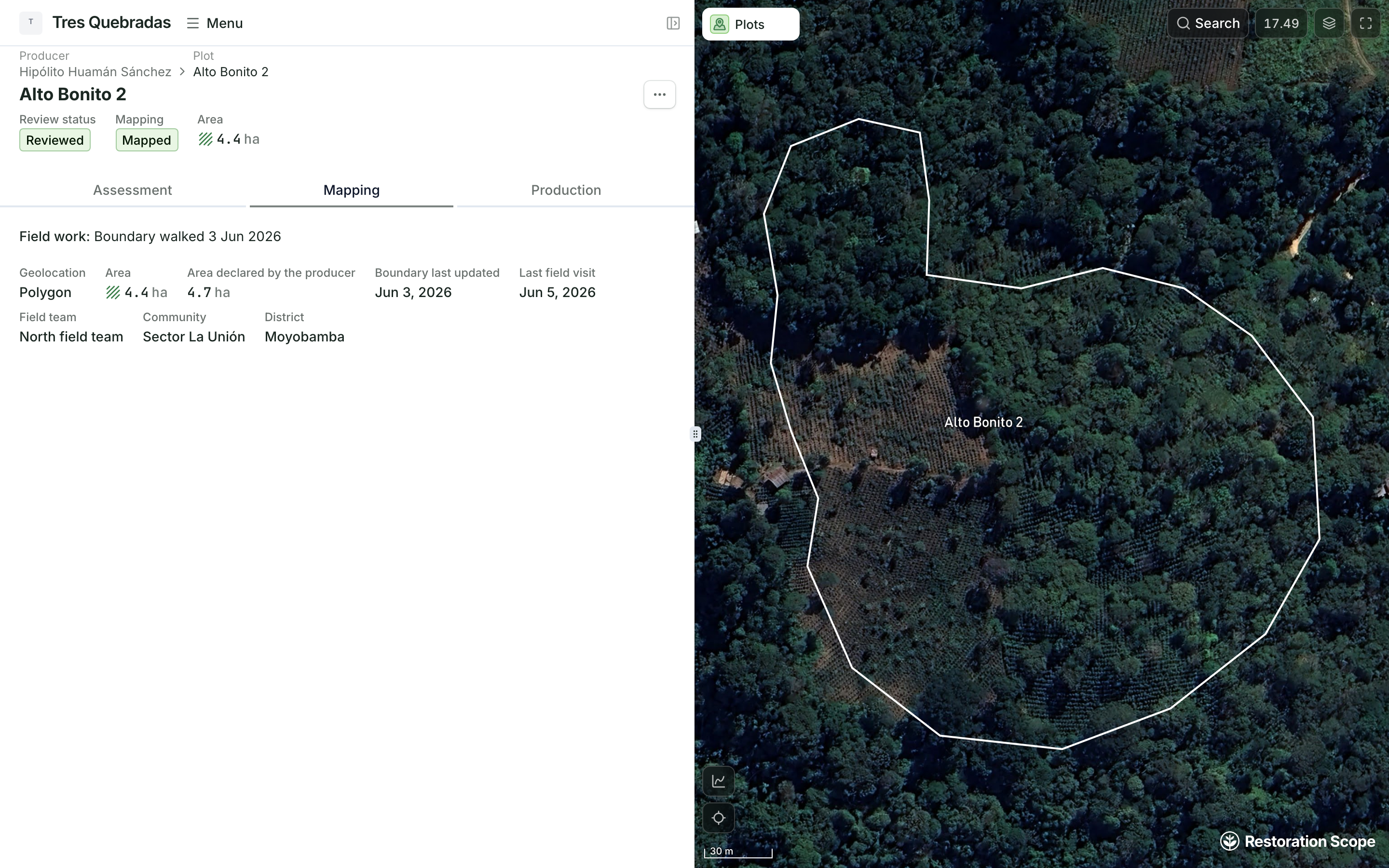
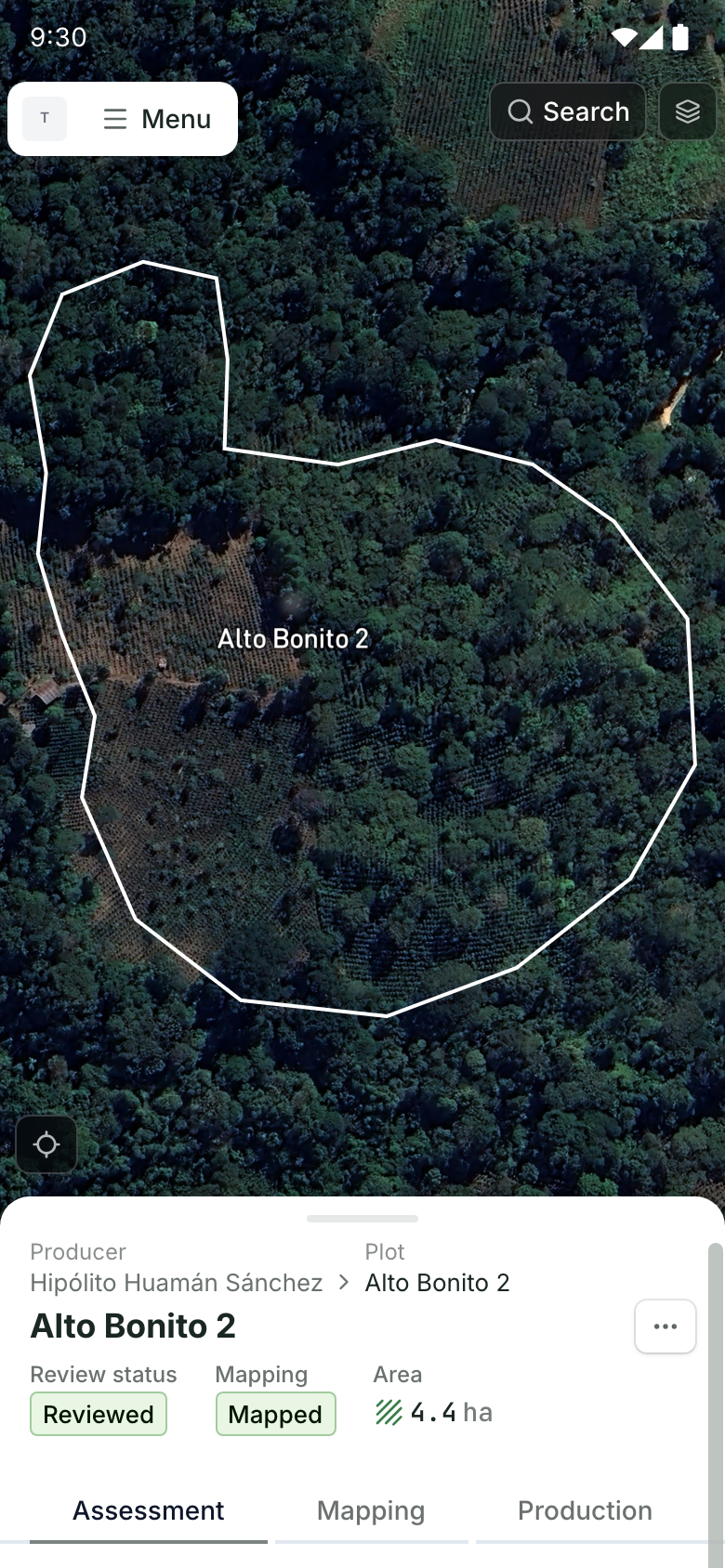
What the field team last saw.
A plot's record keeps when its boundary was last walked, its mapped area against the area the member declared, and which team went. On the phone, the same plot in the field. Demo cooperative: producers, plot records, risk cases and field visits are made up, and deforestation statuses, check results and cutoff figures are not computed by Restoration Scope. Plot locations, map layers and imagery are real.
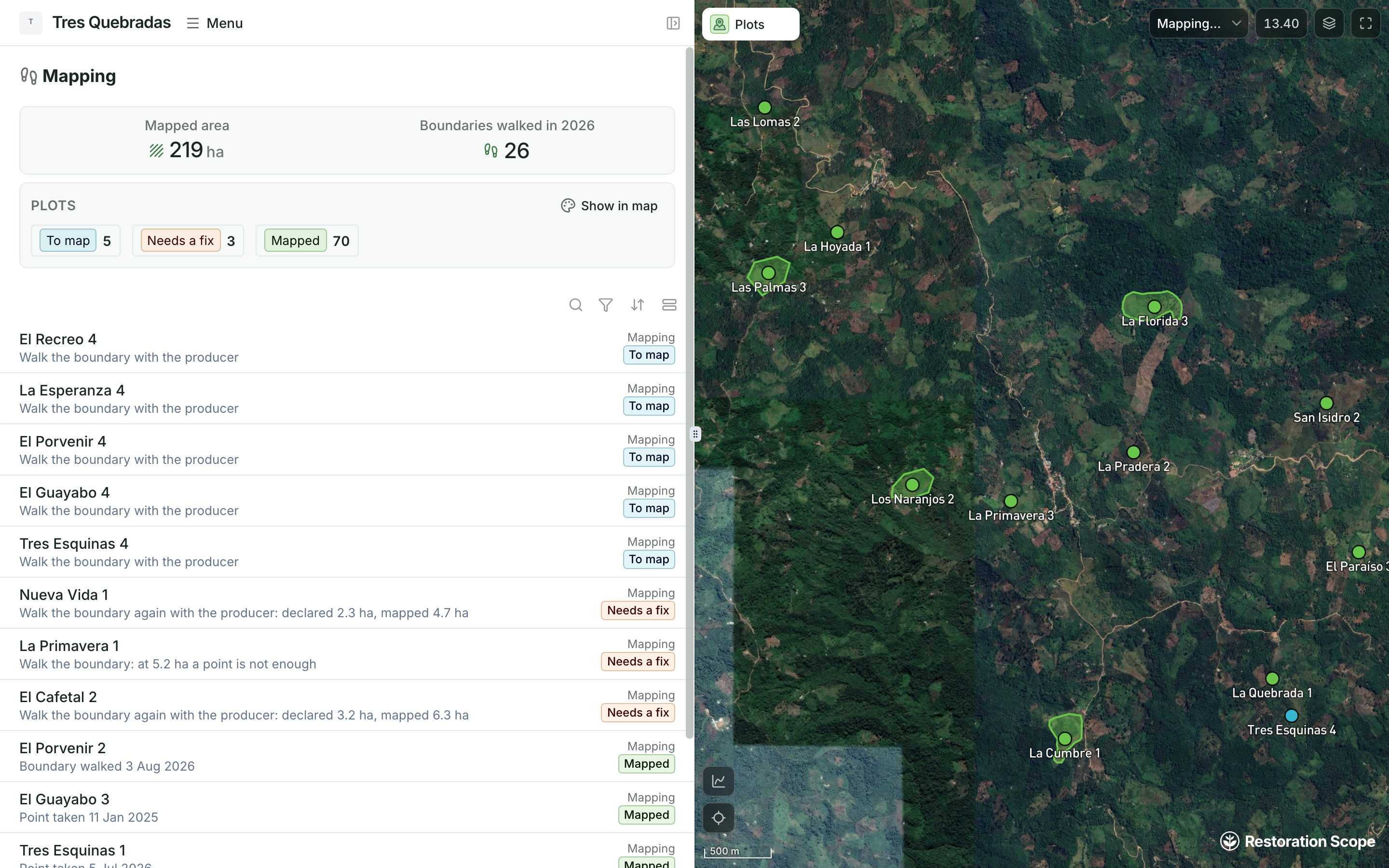
Which boundaries to walk next.
Hectares mapped, boundaries walked this year, and the field team's list of plots to map or fix, beside the map coloured by mapping status. Demo cooperative: producers, plot records, risk cases and field visits are made up, and deforestation statuses, check results and cutoff figures are not computed by Restoration Scope. Plot locations, map layers and imagery are real.
Good fit: a cooperative with field teams that wants its plot list, harvest and lots kept current in one place, with help setting it up.
Think twice if: you want a verdict on each plot. We don't run an automatic cutoff check, give a compliance verdict or file statements; your team, and your buyer, make the call.
Cost: a free pilot on a sample of your data, then a platform license plus implementation, quoted after a scoping call.
Where to start
Start with step 1 this week: a list of every member and plot, even if half the plots aren't mapped yet. It shows the size of the job and is the first thing a buyer will ask for. Then map the plots of the members who supply your largest EU buyer first. Exporters who buy from you will ask for the same data; see EUDR for exporters for what they need.
Learn everything about the EUDR
From what the regulation asks to mapping plots, tracing lots and reviewing the evidence, in the order teams need it.
Map every plot
- GuideEUDR for cooperativesYou’re reading this
- GuideWhat geolocation the EUDR requires
- GuideTools for EUDR geolocation data
- Free toolField plot template
- Free toolPlot file checker
- ProductMapping plots in Restoration Scope
Trace each lot to its plotsUp next
Frequently asked questions
Does the EUDR apply to cooperatives outside the EU?
Not directly. If a cooperative sells through an exporter or importer and does not place the coffee or cocoa on the EU market itself, the EUDR puts no direct legal duty on it. But its EU buyer needs the cooperative's plot locations, production dates and land documents before lawfully placing the goods on the EU market once the rules apply, so the work lands on the cooperative anyway.
What data does an EU buyer ask a cooperative for?
For every lot, the plots it came from with their geolocation, the country of production, when it was harvested, who the producers are, and evidence that the land was not deforested after 31 December 2020 and was farmed legally.
Does every member's plot need a polygon?
Only plots of more than 4 hectares. A plot of 4 hectares or less can be a single point with six decimal places. A polygon still shows more, which helps when the buyer compares the plot with forest maps.
Can a cooperative use the simplified declaration?
Only if it is a micro or small primary operator established in a country the EU rates low risk, selling what it grows there. Cooperatives in standard-risk countries such as Peru, Colombia, Brazil, Côte d'Ivoire and Ethiopia cannot use it.
When does a cooperative have to be ready?
The rules apply from 30 December 2026. Qualifying micro and small operators established as such by 31 December 2024 have until 30 June 2027, except for products from the old EU Timber Regulation. Traders and downstream operators follow the December 2026 date. Buyers ask for data before their own date, so cooperatives selling to large importers need plot data for the harvest placed on the EU market from 30 December 2026.
Another question? Email us or book a call.