What Changed in the EUDR: A Dated Log of Every Delay and Update
Every EUDR change since 2023, dated and linked to its official source: two delays, the country risk list, the product list update and the information system.

The EU Deforestation Regulation (EUDR) entered into force on 29 June 2023; its obligations were delayed by a year in December 2024 and again in December 2025, which simplified rules for downstream companies and some small producers. The Commission adopted information system rules (December 2024), the country risk list (May 2025) and a product list update (2026). As of 2 November 2026, the rules apply from 30 December 2026; operators that are natural persons or micro or small companies, established by 31 December 2024, have until 30 June 2027, except for EU Timber Regulation products. No further delay is proposed.
For the dates that apply to your company today, use the  EUDR delay checker. For what the regulation asks, start with what is the EUDR?
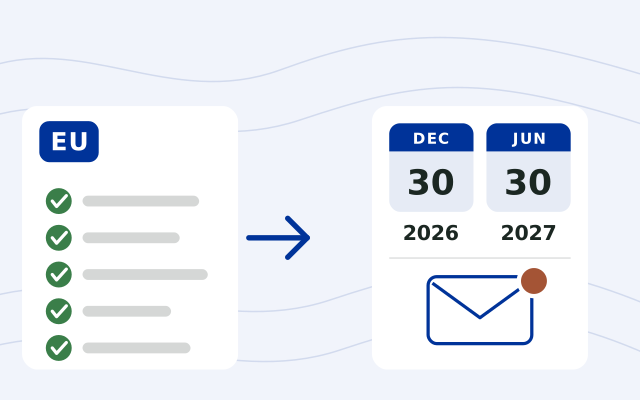
Checked 2 November 2026: each date against its source, linked in each entry: the act on EUR-Lex, the procedure in the European Parliament's Legislative Observatory or the Commission's own page. EU sources © European Union, summarised by us under CC BY 4.0. A plain-language summary, not legal advice.
What changed in 2026, and what comes next?
- 16 February 2026The information system is limited while the Commission updates it for the new rules: no new registrations, the acceptance server off and the live server read-only (
Commission notice of 12 February 2026).
- 4 May 2026The Commission's simplification review,
COM(2026) 191, doesn't consider it appropriate to propose further amendments to the basic legal text. It comes with an updated guidance document and FAQ and a draft update to the product list open for feedback until 1 June (press release). The review plans repositories of producing countries' laws and of certification schemes before the rules apply in December 2026 (section 4.4).
- End of June 2026The information system reopens, according to the
Commission's news of 13 July 2026. It gives no exact day.
- 13 July 2026The Commission adopts the product list update, which then waits for the Parliament and the Council (see 18 September), and
- 20 July 2026The Commission's
- 10 September 2026The Commission proposes taking French Guiana out of the EUDR's territory,
COM(2026) 661. Products moving between French Guiana and the rest of the EU would stay covered, both ways. The Council decides after consulting the Parliament; as of 2 November 2026, the Parliament is still at the preparatory stage, with no committee named.
- 18 September 2026
- 12 October 2026The Commission updates its
list of competent authorities. It names no authority for Greece, Malta or Poland. Each country's authority and penalties are in EUDR competent authorities and penalties.
- 15 October 2026The information system sends each due diligence statement to the competent authority of the EU country where the operator is established, or, for an operator outside the EU, of the country its identifier in the system is linked to (
- Today
- 30 December 2026The obligations apply to most operators, and the lighter ones for traders and downstream operators apply to all of them, whatever their size. The EU Timber Regulation is repealed, but it still applies until 31 December 2029 to timber produced before 29 June 2023 (
- 30 June 2027The obligations apply to operators that are natural persons or micro or small companies, established as such by 31 December 2024, except for products already covered by the EU Timber Regulation (
- 30 December 2027Soluble coffee, some palm oil derivatives and frozen cattle tongues join the product list (
- 30 June 2030The Commission's first general review of the regulation is due (
What changed in 2025?
- 22 May 2025The Commission adopts the country risk list,HS code and country lookup shows each country's tier.
- 12 August 2025A new version of the Commission's
- 21 October 2025The Commission proposes targeted amendments to the regulation, COM(2025) 652 (
- 4 December 2025The Parliament and the Council reach a provisional agreement: a second year of delay and simpler obligations (
- 23 December 2025The second delay,
What changed in 2023 and 2024?
- 31 May 2023The Parliament and the Council sign the EUDR,
- 29 June 2023The EUDR enters into force, the twentieth day after its publication (
- 2 October 2024The Commission proposes a one-year delay, COM(2024) 452 (
- 13 November 2024The Commission's first
- 4 December 2024The Commission adopts the rules for the information system,
- 23 December 2024The first delay,
How did the application dates move?
| Act | Most operators | Micro and small operators |
|---|---|---|
| Regulation (EU) 2023/1115, as signed | 30 December 2024 | 30 June 2025 |
| Regulation (EU) 2024/3234 | 30 December 2025 | 30 June 2026 |
| Regulation (EU) 2025/2650 | 30 December 2026 | 30 June 2027 |
The later date has always excluded products covered by the EU Timber Regulation. It first covered operators established as micro or small companies by 31 December 2020; since the 2025 amendment, it covers natural persons and operators established as micro or small companies by 31 December 2024.
How do we keep this log current?
A script reads the official EUDR pages every morning for the EUDR delay checker, and a person on our team reads each change before this log or the checker is updated. The checker can email you when the dates change. If you spot a change we've missed, write to us at info@restorationscope.com.
Disclosure: Restoration Scope publishes this log. We make field and plot software that exporters and cooperatives use to keep plot data for the EUDR. No one paid for or reviewed this page.
Learn everything about the EUDR
From what the regulation asks to mapping plots, tracing lots and reviewing the evidence, in the order teams need it.
Understand the rule
Questions about EUDR changes
Has the EUDR been delayed again?
Not as of 2 November 2026. It was delayed twice, by a year each time: by Regulation (EU) 2024/3234 in December 2024 and by Regulation (EU) 2025/2650 in December 2025. The Commission's review of 4 May 2026 doesn't consider it appropriate to propose further amendments to the basic legal text, and no proposal to change the dates is pending. The only pending amendment, COM(2026) 661, would take French Guiana out of the EUDR and changes no date. The EUDR delay checker shows the dates that apply now.
When does the EUDR apply now?
From 30 December 2026. Operators that are natural persons or micro or small companies, established as such by 31 December 2024, have until 30 June 2027, except for products already covered by the EU Timber Regulation. Traders and downstream operators follow the December 2026 date whatever their size.
What changed in the EUDR in December 2025?
Regulation (EU) 2025/2650 added a second year of delay and simplified the rules: downstream operators and traders no longer file due diligence statements, micro and small primary operators in low-risk countries file a one-off simplified declaration instead of due diligence statements, unless the information is already in an EU or national database, printed books, newspapers and other printed products left the product list, and the Commission had to review the regulation by 30 April 2026.
Which products were added to or taken out of the EUDR in 2026?
Delegated Regulation (EU) 2026/2102, in force since 18 September 2026, takes cattle hides, skins and leather, soya beans for sowing, conveyor and transmission belts and other vulcanised rubber articles not listed elsewhere in Chapter 40, and aircraft and motor vehicle seats out of scope, and narrows retreaded and used tyres (heading 4012) to tyre treads alone. It adds soluble coffee, some palm oil derivatives and frozen cattle tongues from 30 December 2027. The HS code lookup shows each code.
Has the EUDR country risk list changed?
Not as of 2 November 2026. The list is still the one in Implementing Regulation (EU) 2025/1093 of 22 May 2025, and the EU Publications Office records no act amending it. It rates Belarus, Myanmar, North Korea and Russia high risk, 140 countries low risk and every other country standard. The Commission said in 2025 that it plans to review the list in 2026, using new FAO forest data (its reply to the Parliament).
Another question? Email us or book a call.
Based on the official EU texts. See our EUDR sources, with the version we follow and the day we last checked each one.