Isometric vs Verra: How the Two Carbon Registries Compare for Nature Projects
Compare Isometric and Verra for reforestation and other nature projects by methodology, field data, buffer, issuance speed, fees, ICVCM label and CORSIA status.
Verra is the established registry for nature credits: a US nonprofit whose VCS program covers reforestation, forest management, REDD+ and wetlands, where the developer hires the verifier and pays the fees. Isometric is a younger company that started in carbon removal. For nature it has reforestation, agroforestry, mangrove, forest management and savanna fire protocols; it picks and pays the verifier, charges the buyer, and publishes the data behind each certificate. Both issue credits only after verification and have an ICVCM-approved reforestation methodology, though Isometric's approval covers an earlier version. Verra credits can qualify for CORSIA; Isometric's nature credits can't yet.
It compares published rules, not outcomes, and is not legal or investment advice. First-party documents checked November 2, 2026. For the other standards, see carbon standards for nature projects compared.
Isometric vs Verra at a glance
| For nature projects |  Isometric |  Verra VCS |
|---|---|---|
| Nature methods |
|
|
| Credits issued before trees grow | No | No |
| Fees paid by | The buyer | The developer |
| Buffer | 20% flat, or set by a risk model (10% minimum, 8% for IFM; savanna fire is flat only), into a shared pool | Set by a risk tool, 12% minimum, into a shared pool |
| ICVCM quality label (reforestation) | Version 1.1 approved; current 1.2 not yet | Approved, VM0047 1.0 and 1.1 (current) |
| CORSIA airline eligibility, 2024–2026 | No, nature credits excluded | Yes, with conditions |
| Verifier | Chosen and paid by Isometric | Hired and paid by the developer |
| Reforestation baseline | Each project pixel matched to 10 or more satellite control pixels | Satellite stocking index for the project, against matched control plots |
| Project data made public | Yes, the data behind each certificate, unless marked confidential | Project documents and calculations |
| Run by | Isometric HQ Limited, a company | Verra, a US nonprofit |
Status as of November 2, 2026.
Which nature projects each covers
Isometric. Reforestation (version 1.2) for land that once held forest and wasn't deforested in the past 10 years; Agroforestry (1.1); Mangrove Restoration (1.1); and Improved Forest Management (1.1), credited through modules for smallholders deferring harvest and for logged forest moved into protection. A savanna fire protocol, certified in October 2026, credits both carbon stored and cuts in methane and nitrous oxide. An avoided deforestation protocol was announced in September 2026 and isn't certified yet.
Verra. VM0047 (1.1) for afforestation, reforestation and revegetation, with an area-based approach and a census-based one for up to 50 planting units, such as trees or shrubs, per hectare on land that stays in use; VM0045 (1.2) for forest management in the contiguous United States, against national forest inventory plots, with a version for other countries consulted on in May 2026; VM0048 for REDD+; and VM0033 (2.1) for tidal wetlands and seagrass, with a version 3.0 consulted on in September 2026.
What each asks from the field
Both build the reforestation baseline from satellite data and both treat field plots as the measure of what grew. The difference is how often you go back, and who sees the result.
Isometric. Biomass comes from field plots, from LiDAR, or from global biomass maps, and the last two still need field plots "as the source of truth for benchmarking the maps". With field plots alone, you sample them at the start and end of every reporting period; with LiDAR or maps, at least every five years. Inside each sample plot, every tree over 10 cm in diameter gets a species and a diameter. Validation and the first verification include site visits to the plots. Each project pixel is matched with at least 10 control pixels to set the baseline (Reforestation 1.2, sections 7, 9 and 12). Isometric publishes the data, calculations and evidence behind each certificate, though a developer can ask to restrict some of it to buyers and the verifier (Isometric carbon; Reforestation 1.2, section 7.6).
Verra. An area-based project compares a satellite stocking index for the project with matched control plots, and measures above-ground biomass in sample plots every five years or more often. A census-based project counts every planted tree and measures a sample of them. Credits are cut by the half-width of the 90% confidence interval, as a share of the estimate, minus 10 points, and none are issued once that half-width passes 100% of the estimate. Verra keeps a list of vetted stocking index providers, added five on October 28, 2026, and projects may also use others. Project documents and calculation spreadsheets are public, except commercially sensitive information; Verra's document list doesn't name plot-level field data. From July 1, 2027, VCS version 5 asks for a geolocation file at validation and at each verification (VM0047 1.1, VCS version 5 dates).
See what VM0047 asks you to record and how many inventory plots an ARR project needs.
Buffer and permanence
Isometric. 20% of each reporting period's credits go to a forestry buffer pool, or a project-specific risk model sets the share, with a 10% floor (8% for forest management). After crediting ends, reforestation and mangrove projects keep monitoring for 40 to 100 years; agroforestry commits 40 to 120 years in total. If a reversal was avoidable, later credits go to the pool until it is repaid; after crediting ends, the developer repays it with certificates from its other projects or from another project Isometric accepts. Since October 20, 2026, reforestation projects can use approved insurance in place of part of their buffer contribution, now set out in Standard 2.2; the protocol text hasn't been updated to match yet (Reforestation 1.2, section 10; Standard 2.2, section 5.6).
Verra. Credits go to the pooled AFOLU buffer, sized by Verra's non-permanence risk tool. The lowest rating is 12%. A project fails if its total rating is above 60%, or if internal or natural risk is above 35% or external risk above 20%. Longevity and monitoring run at least 40 years; the crediting period can be shorter. After an avoidable reversal, Verra issues no more credits to that project or the developer's other projects until it is repaid. If no verification report is submitted within five years of the last approved verification request, all the project's buffer credits are put on hold; from July 1, 2027, reforestation and forest management projects that have reached their long-term average are exempt (VCS Standard 5.0, section 3.2; Registration and Issuance Process 5.0, section 5.3.6; risk tool procedure).
How fast credits are issued
Neither issues credits for trees that haven't grown yet. Both credit verified growth only.
Isometric. Reforestation reporting periods normally run one to five years, and the first can be longer to allow for tree growth. Credits are issued when a period is verified, so the first issuance comes at least a year after the start. Validation can happen with the first verification. The project comment period is 10 days, extended to 30 if material comments arrive or a stakeholder asks for more time (Standard 2.2, sections 3.3 and 4.2). Isometric says certificates are "issued in days" once a project is verified (Isometric carbon).
Verra. Validation can start during the 30-day public comment period, and Verra says it "can take up to a year, in some cases longer". A project can also request registration and its first verification review together. Its own reviews take up to 40 business days, plus up to 20 for each round of responses, and a review may take two or three rounds (VCS FAQ). For requests from July 1, 2027, version 5 has projects list within one year of the crediting start, reforestation projects request registration within eight years of it, and every project request a verification at least every five years (VCS Standard 5.0, section 3.8; Registration and Issuance Process 5.0, section 4.1.2).
What each costs
At Isometric the buyer pays one fee per tonne on delivery; at Verra the developer pays each fee below. Neither schedule includes your own project design, planting or field costs.
| Cost | Isometric | Verra VCS |
|---|---|---|
| Before registration | No fee | $1,500 listing, $3,750 registration review |
| Registry account | No fee | $750 to open plus $750 a year, both due at approval ($1,500 in year one) |
| Verifier (VVB) | Included in the per-tonne fee | Paid separately by the developer |
| Per verification | Included in the per-tonne fee | $5,000 review, $2,500 of it credited toward levies |
| Per tonne | $2.00–5.00, paid by the buyer, lower when the supplier issued more the year before | $0.23 per tonne claimed |
Fees as of November 2026.
Isometric's 2026 fee for nature projects, which it calls Biosphere, is $5.00 a tonne when the supplier issued fewer than 100,000 certificates under that protocol the previous calendar year, and falls in steps to $2.00 at 350,000 and above; tiers are reset each January 1 (pricing). Verra charges its $0.23 on the tonnes claimed; if fewer credits are approved, the same total is spread over those issued. Verra also charges $0.02 a credit to transfer or retire, billed to the account that makes the move (
fee schedule 1.2). At Isometric the fee is the buyer's, so it shows up in the price you negotiate rather than in your budget. See what a carbon project costs.
How buyers see the credits
- ICVCM label. Both programs are CCP-eligible. Approved for nature: Verra VM0047 (1.0 and 1.1), VM0045 1.2 and VM0048; Isometric Reforestation 1.1, Agroforestry 1.0 and Mangrove Restoration 1.0. Isometric's current versions (Reforestation 1.2, Agroforestry 1.1, Mangrove 1.1), which new projects use unless Isometric allows an earlier one, and its forest management protocol are not approved yet, so check the version a buyer needs (
ICVCM status).
- Airlines (CORSIA). Verra is approved for 2024–2026 and 2027–2029, when the host country authorizes the credits and a corresponding adjustment is applied or guaranteed. A VM0047 or VM0048 project in a REDD+ country, estimated at registration to issue more than 7,000 credits a year, is left out unless nested in a jurisdictional program; VM0033 wetland projects are exempt from that rule, and only Scenario 2a or 3 of Verra's jurisdictional framework counts as nested. Isometric is approved for 2024–2026 with all its nature credits excluded (
ICAO eligible units). It has applied for 2027–2029, and ICAO says its Council considers that round in November 2026 (ICAO TAB).
- Volume. Verra says it has issued over 1.3 billion credits through VCS, and has over 4,254 active projects in 134 countries across its programs (
Verra). Isometric says it has over 16 million tonnes contracted and over 100 signed buyers, across all its pathways (
Isometric carbon).
- Who buys. Isometric is endorsed by Frontier, the carbon removal buyers' coalition, is
conditionally endorsed by ICROA, and names Microsoft, Anglo American, Boeing and JPMorgan Chase among those who trust its certification (
Which one fits your project
Isometric
Good fit: Reforestation, agroforestry, mangrove or smallholder forest projects selling to removal buyers who want each certificate's data in public and are willing to pay the certification fee. You pay no registry or verifier fees up front.
Plan for: Your project's data published, unless you mark parts confidential. Isometric chooses your verifier, and the same one can serve a project for at most five consecutive years, and five in any seven. No REDD+ yet, and no CORSIA for nature credits today.
Verra VCS
Good fit: Reforestation, REDD+ and wetland projects in most countries, and US forest management, selling to the largest buyer market, including airlines under CORSIA where the project meets its conditions. VM0047's census-based approach fits trees planted on farms.
Plan for: Upfront fees, your own verifier contract and a validation that can take a year. Most VCS version 5 rules apply from July 1, 2027, with the VCS version 5 transition dates varying by rule.
What both verifiers check
Whichever registry you choose, the credits rest on the same field record: plots you can find again years later, the species and diameter of the trees in them, boundaries that match the geolocation file, and who measured what and when. Isometric publishes the data behind each certificate; Verra's verifier remeasures a sample of it. Either way it has to hold up a decade on, after crews and spreadsheets have changed.
Restoration Scope keeps properties, plots, trees, measurements and photos connected on one map, with offline capture for field crews. It doesn't calculate credits or replace your verifier. See Restoration Scope for carbon projects.

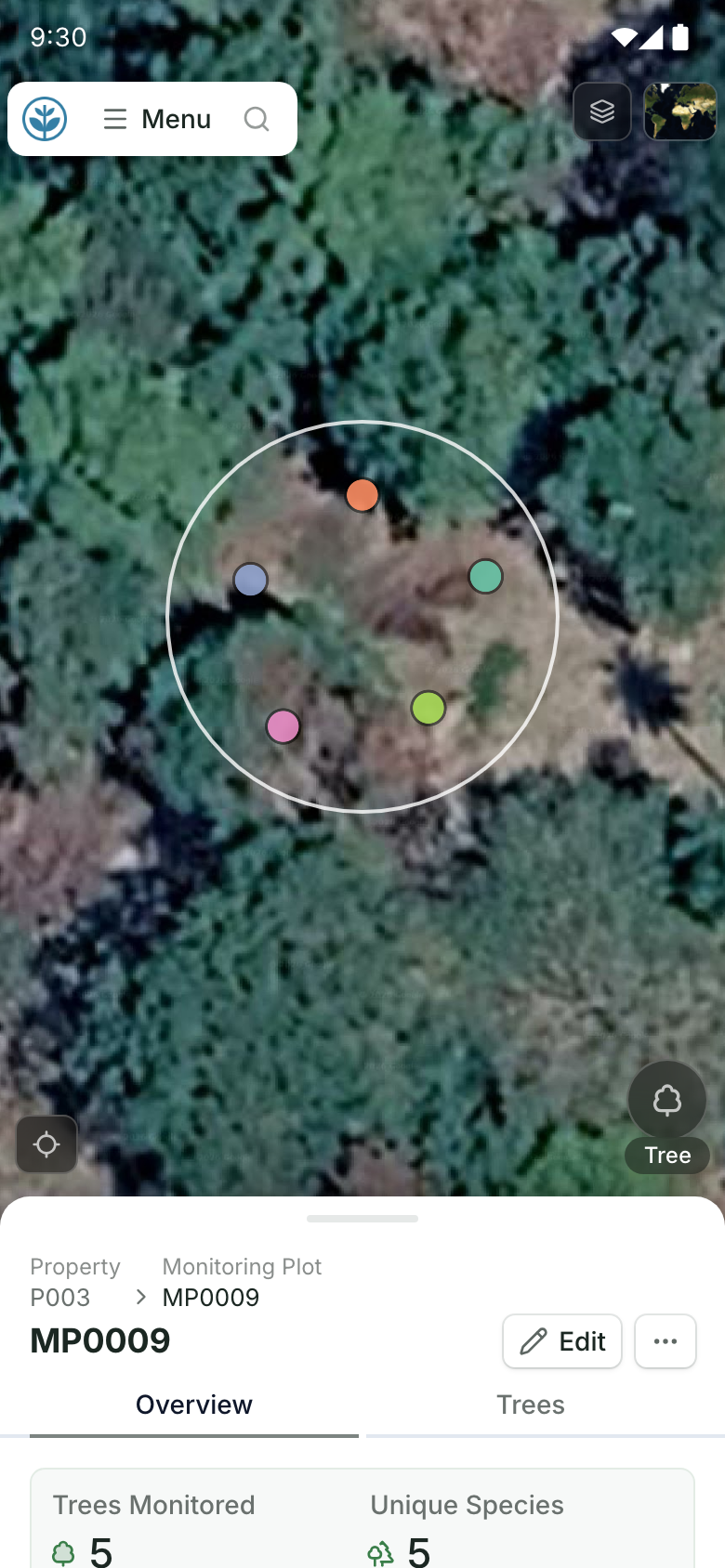
Parcels and plots in one place.
Each property's status, owner and area, beside its boundary on the map. Field teams open a monitoring plot on their phones: the plot circle with each measured tree inside it, above the plot record. Demo project: names and numbers are made up.
More guides: carbon standards for reforestation, IFM carbon standards, blue carbon standards and Plan Vivo vs Gold Standard vs Verra.
Disclosure: Restoration Scope makes field and monitoring software for carbon project developers. We are not a standard, a registry or a verifier, and we don't issue credits.
Questions developers ask about Isometric and Verra
Is Isometric or Verra better for a reforestation project?
It depends on who buys your credits. Verra has the largest market for nature credits, covers more nature project types, including REDD+, and its credits can qualify for CORSIA. Isometric suits removal buyers who want each project's data published and pay the certification fee themselves; its reforestation credits don't qualify for CORSIA today. Verra's current reforestation methodology carries the ICVCM label; Isometric's label covers version 1.1, and new projects use 1.2 unless Isometric allows the earlier version.
Who pays the fees at Isometric and at Verra?
At Isometric, the buyer pays a per-tonne fee on delivery that includes the verifier; the developer pays Isometric nothing. At Verra, the developer pays listing, registration and verification review fees plus $0.23 for each tonne claimed at verification, and hires and pays its own verifier. As of November 2026.
Does Isometric issue credits faster than Verra?
Neither issues credits before verification, and both let a project validate together with its first verification. Isometric reforestation projects normally verify every one to five years, and Isometric says certificates are issued in days once verified. Verra says validation can take up to a year, sometimes longer, and its own reviews take up to 40 business days plus up to 20 for each round of responses.
Can Isometric nature credits be used under CORSIA?
Not for 2024–2026. ICAO approved Isometric for that phase but excluded its reforestation and other nature credits. Isometric has applied for 2027–2029, and ICAO says its Council considers that round in November 2026.
Do Isometric and Verra carry the ICVCM label?
Both programs are CCP-eligible. ICVCM has approved Verra's VM0047 (versions 1.0 and 1.1), VM0045 version 1.2 and VM0048, and Isometric's Reforestation 1.1, Agroforestry 1.0 and Mangrove Restoration 1.0. Isometric's newer versions and its forest management protocol are not approved yet.
Does Isometric certify REDD+ projects?
Not yet. Isometric announced an avoided deforestation protocol in September 2026; it was not certified as of November 2, 2026. Verra certifies REDD+ under VM0048.
What field data do Isometric and Verra both need?
Field plots that can be found and remeasured, tree measurements such as species and diameter, project boundaries, and a record of who measured what and when. Isometric publishes the data behind each certificate unless marked confidential; Verra's verifier checks a sample in the field. See Restoration Scope for carbon projects.
Another question? Email us or book a call.