Improved Forest Management (IFM) Carbon Standards Compared
Compare improved forest management standards (ACR, Verra VM0045, Climate Action Reserve, Isometric and BioCarbon) by baseline, forest inventory rules, monitoring term and ICVCM status.
Improved forest management (IFM) projects earn credits for keeping more carbon in a working forest than its owner otherwise would: longer rotations, lower harvests, or harvest deferred altogether. The biggest difference between standards is the baseline, the forest you are compared against. The second is how often your foresters go back to the plots.
This guide compares IFM standards by baseline, inventory rules, commitment and ICVCM status. It compares published rules, not outcomes, and is not legal or investment advice. First-party documents checked October 18, 2026.
Compare IFM standards
| Standard | Methodology | Where | Baseline | ICVCM label |
|---|---|---|---|---|
| IFM on Non-Federal US Forestlands v2.1 | US private, state, municipal and tribal forests | The harvest the owner could legally carry out, rechecked at each verification | Approved (v1.3, v2.0, v2.1), with version-specific conditions | |
| IFM on Small Non-Industrial Private Forestlands v1.0 | US family forests, 40–5,000 acres per site | A practice-based performance standard | Under assessment | |
| VM0045 v1.2 | The US, until other national inventories are approved | Matched plots from the national forest inventory, updated as they are remeasured | Approved (v1.2) | |
| US Forest Protocol v5.1 | US private, state, municipal and tribal forests | Regional common practice, through a default calculation or a modeled baseline | Under assessment | |
| Mexico Forest Protocol v3.0 | Mexican ejidos, communities and private land | Only growth above the starting carbon stock counts | Approved for IFM, with conditions | |
| Improved Forest Management v1.1 | Smallholder deferred harvest, and logged forest turned to protection | Matched control areas, set by Isometric at each verification | v1.0 under assessment | |
| BioCarbon Standard | BCR0010, IFM and avoided planned conversion | Natural forest with a harvest permit or concession | The legally authorized harvest plan | Under assessment |
ACR also has an IFM methodology for Canadian private and Indigenous forestlands, under ICVCM assessment. Verra's older IFM methodologies (VM0003, VM0010 and VM0012) are still active and also under assessment. Gold Standard has no IFM methodology. Status from the ICVCM assessment page.
What each standard asks of your forest inventory
| Standard | Plot data age | Precision target | Verification and site visits | Commitment |
|---|---|---|---|---|
| No plot data older than 10 years | ±10% at 90% confidence; error above that is deducted | Each issuance; a site visit for the first and at least every 5 years | 20-year crediting, 40-year minimum term | |
| Project plots remeasured at least every 5 years, baseline plots every 10 | Only uncertainty above 15% at 95% confidence is deducted | A site visit at validation, first verification and each baseline reassessment | At least 40 years; crediting 20–100 years | |
| No plot data older than 12 years | ±5% at 90% confidence; larger errors are deducted, and 20% or more is not accepted | Annual monitoring reports; a site visit at the start, then at least every 6 reporting periods, or 12 for small projects, with conditions | 100 years of monitoring after each issuance | |
| Set by the protocol | ±5% at 90% for one activity area, relaxing to ±20% with 15 or more | Annual reports; full verification at least every 6 reporting periods | 30–100 years, with credits in proportion | |
| Remeasured at least every 10 years under the smallholder module | A conservative estimate from the lower range of the result | Reporting periods of 1–5 years | At least 40 years | |
| BioCarbon | Recommended: biomass every 5 years, harvest records every year | ±10% at 90% confidence for key parameters; deduction rules vary | Set by the program | Set by the program |
Where each standard fits
 ACR
Good fit: US forest owners with title or timber rights to the whole project area, from large timberland owners to family forests through the small-landowner methodology. ACR issued the first credits under that methodology in August 2026.
Plan for: A baseline your forester has to defend. Version 2.1 caps how hard the baseline can harvest, rechecks it at each verification with ACR's dynamic evaluation tool, and asks a professional forester to attest to its constraints. Harvested projects also need certification (FSC, SFI or ATFS), a state or federal forestry program, or, for owners under 5,000 acres, a forester's long-term plan.
 Verra VCS
Good fit: US projects that want a baseline built from measured forests rather than a model. VM0045 pairs each project plot with weighted plots from the national forest inventory in the same ecoregion, so the baseline follows what similar forests actually do over time.
Plan for: Permanent plots where every tree is uniquely marked, by tag or paint, and mapped by bearing and distance, remeasured at least every five years. Outside the US, Verra's IFM options today are its older methodologies, which don't carry the ICVCM label.
 Climate Action Reserve
Good fit: US forests with more carbon than the regional common practice, and Mexican ejidos and communities with an authorized forest management program. In Mexico, the community assembly approves the 30- or 100-year crediting period.
Plan for: In the US, 100 years of monitoring after each issuance and annual monitoring reports. In Mexico, the ICVCM label applies only to IFM projects that commit to at least 40 years and apply the protocol's variable market leakage rate (announcement).
 Isometric
Good fit: Smallholders deferring harvest, and logged forest moved into protection under a second module. The first module, Deferred Harvest on Smallholder Lands, covers owners with up to 2,000 hectares and sites over 10 hectares, and requires at least 40% of revenue to reach landowners.
Plan for: Isometric sets the matched baseline itself at each verification. The buffer is 20%, or a project-specific amount of at least 8%.
BioCarbon Standard
Good fit: Natural forests in Latin America where a concession, permit or management plan already authorizes harvesting that would degrade the forest, and the project avoids it.
Plan for: Proving the baseline with the documents behind it: harvest plans, concession contracts, pre-harvest inventories and logging schedules.
What your field team has to keep
IFM projects live on their inventory. Across these methodologies, the record a verifier checks includes:
- Boundaries. GIS maps of the project area, the parcels and the strata, and title or timber rights for all of it.
- Plots. Plot locations, the inventory SOP and sample design, and every measurement: species, diameter, height and dead wood where counted. Under VM0045, each tree's mark and position.
- Harvests. Mill receipts or other harvest records for anything cut during the reporting period, plus disturbances such as fire, storms or pests.
- Management. The management plan, certification, and records or field reports showing the activities happened.
- Check measurements. Verifiers remeasure a sample of your plots. ACR asks for at least the square root of the plot count, so plots have to be findable years later.
A forest inventory that lives in a contractor's spreadsheet is hard to defend at the next verification. Restoration Scope keeps stands, plots, tagged trees, harvests and photos connected on one map, with offline capture for field crews. It doesn't calculate credits or replace your forest biometrician. See Restoration Scope for carbon projects.

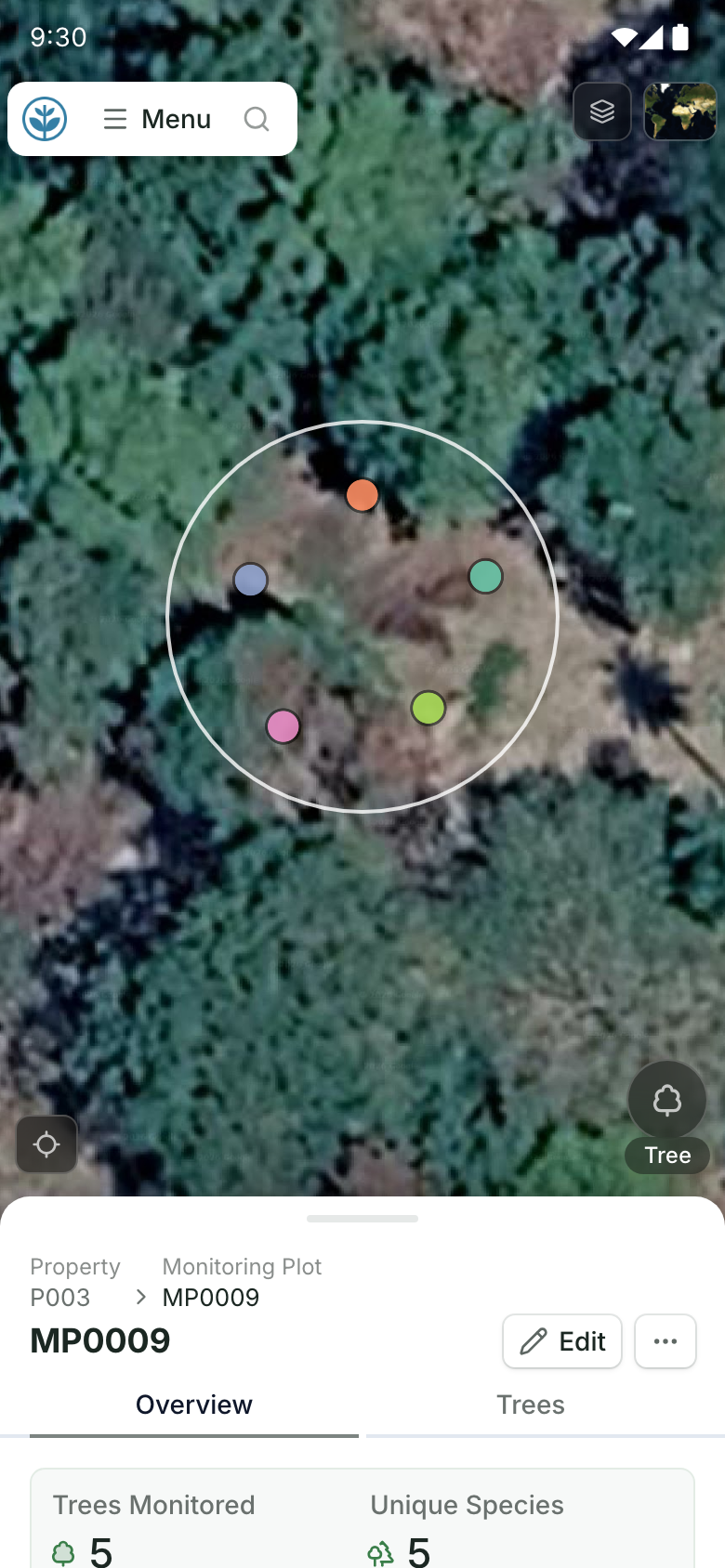
Parcels and plots in one place.
Each property's status, owner and area, beside its boundary on the map. Field teams open a monitoring plot on their phones: the plot circle with each measured tree inside it, above the plot record. Demo project: names and numbers are made up.
More guides: carbon standards for nature projects compared, carbon standards for reforestation, REDD+ standards and blue carbon standards.
Questions IFM developers ask
Which IFM methodologies carry the ICVCM label?
ACR's IFM methodology for non-federal US forestlands (versions 1.3, 2.0 and 2.1, each with its own conditions), Verra VM0045 version 1.2, and the IFM part of the Climate Action Reserve's Mexico Forest Protocol version 3.0 for projects that commit to at least 40 years and apply its variable market leakage rate. Other IFM methodologies are still being assessed.
How often do we have to remeasure inventory plots?
VM0045 remeasures project plots at least every five years. ACR allows plot data up to 10 years old, and the Climate Action Reserve's US Forest Protocol up to 12 years, with growth models filling the years in between.
Can we use VM0045 outside the United States?
Not yet. VM0045 needs an approved national forest inventory to match plots against, and today only the US Forest Inventory and Analysis program qualifies. Verra consulted on a version adding other countries' inventories in 2026, but it has not been published.
What is the difference between IFM baselines?
The Climate Action Reserve starts from regional common practice, through a default calculation or a modeled baseline. ACR and BioCarbon model the harvest the owner could legally carry out. Verra VM0045 and Isometric compare project plots with matched plots outside the project, so the baseline moves with what similar forests actually do.
Which IFM routes suit small family forests?
ACR has a methodology for small non-industrial private forestlands of 40 to 5,000 acres per site, aggregated across owners, and Isometric's first IFM module is for smallholders with up to 2,000 hectares. ACR also allows owners under 5,000 acres to show sustainable management through a forester's long-term plan.
Does monitoring software calculate IFM credits?
Not ours. Standards and verifiers confirm credits. Software keeps the field record behind them: stands, plots, tagged trees, harvests and photos. See Restoration Scope for carbon projects.