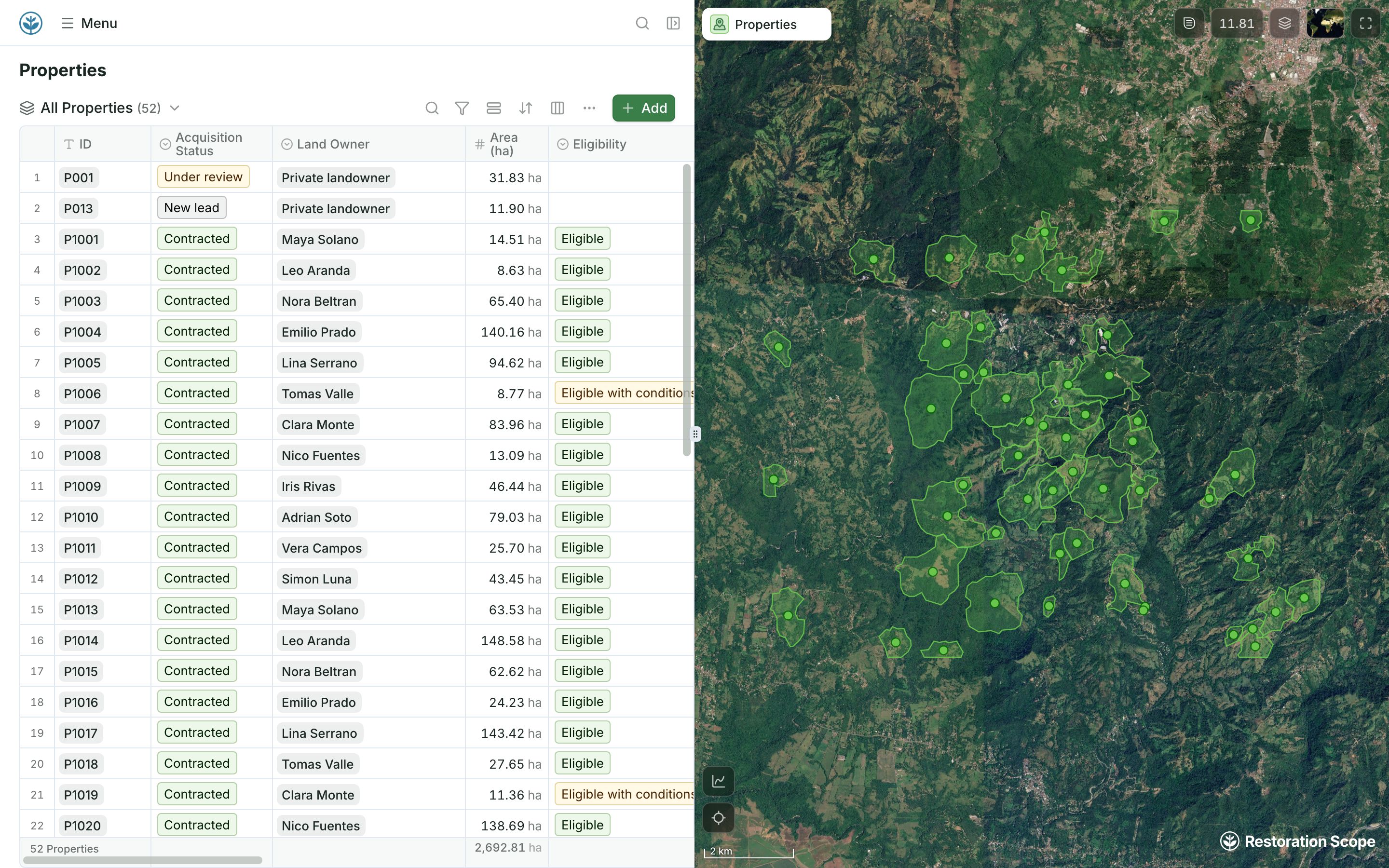
Land and landowners in the same system
Properties carry their acquisition status, landowner, area and eligibility, next to their boundaries on the map.
Open Forest Protocol (OFP) is a carbon registry that comes with its own monitoring tech: an offline forester app, monitoring every six months and then yearly, verification by its validator network, and credits for reforestation and agroforestry projects from 0.3 ha, at no up-front cost. Its team also built NatureGrid, a monitoring platform. Restoration Scope keeps a project’s land, field and monitoring records, configured around the project, under whichever standard it uses.
 Restoration Scope
It depends on what you need. If you want to register a project and issue credits on one registry that brings its own monitoring tools, even for a small project, and OFP’s credits suit your buyers, OFP is built for that. If you want monitoring software you can try today, NatureGrid, from the same team, works across project types and monitoring frameworks, with a free trial. If you want one system set up with you around the whole project, from land agreements and partners to field work and donor portals, Restoration Scope is configured around it.
| Restoration Scope | ||
|---|---|---|
| What it is | A carbon registry for forest projects, which its site calls a digital carbon standard, with its own monitoring tech: an operator dashboard, an offline forester app and a public Atlas of project data. Its team also built NatureGrid, a monitoring platform. | A restoration data platform configured around your project: land and landowner records, a field app, monitoring, maps and portals. |
| Cost | No up-front cost for project developers. A 2023 OFP article puts its protocol fee at 8% of the credits issued; ask OFP for current terms. NatureGrid has a 14-day free trial; prices are not published. | Priced per project after a scoping call. No public price list. |
| Credits | Ex-post credits, issued yearly after verification, for afforestation, reforestation, revegetation and agroforestry projects from 0.3 ha. | We don’t issue or sell credits. We keep the records behind them, under whichever standard you use. |
| Monitoring | Every six months for the first two years, then yearly. Organisations in its validator network check the ground data. | Plots, trees and site visits on your methodology’s schedule, linked to each site across seasons. |
| Field app | The forester app works offline on any smartphone. NatureGrid adds custom forms, monitoring zones, sample plots and remote sensing layers. | The Field App works offline: field teams record surveys, photos and planting areas on the same property maps the office sees. |
| Who sees the data | Project data is shown on its public Atlas, which it describes as an immutable public record. | Records stay with your team. Donor portals, per donor or programme, show what you set up for them. |
| Land and partners | Land tenure and site survey data are part of a project’s eligibility review before it registers. | Land and landowner records, partner programmes and data from Kobo, Google Sheets and GIS files in the same system. |
Checked against Open Forest Protocol's own pages on October 19, 2026: For project developers, NatureGrid, NatureGrid announcement, Protocol fee (2023), Project eligibility.
These are Restoration Scope screens from our demo project and a public donor portal. To see Open Forest Protocol, visit its own site.
Properties carry their acquisition status, landowner, area and eligibility, next to their boundaries on the map.

Each donor or programme gets their own portal, built from the same records the team keeps.
Open Forest Protocol sits beside the ladder: it is a registry that comes with its own monitoring tech. Restoration Scope is an adaptable platform that keeps a project’s records under whichever registry or standard it uses.
Where restoration records live, from word of mouth to custom softwareA monitoring platform built by the Open Forest Protocol team and announced in June 2026: an offline mobile app for observations, photos and plot data, and a web dashboard with validation workflows and remote sensing layers. It works across project types and monitoring frameworks, and offers a 14-day free trial.
Its site says projects join at no up-front cost, whatever their location and size. A May 2023 OFP article puts its protocol fee at 8% of the credits issued; ask OFP to confirm current fees and terms.
Yes. Restoration Scope is not tied to a standard: it keeps land, plot and monitoring records set up for your methodology. We are not a registry or a verifier, and we don’t issue credits.
For the project’s records, yes; for registering and issuing credits, no. OFP is a registry with its own monitoring tech. Restoration Scope keeps the project’s records under the standard you choose.
Restoration Scope publishes this comparison. Something out of date? Write to info@restorationscope.com.
Bring in the spreadsheets, field forms and maps you already use, and see every site in one place.